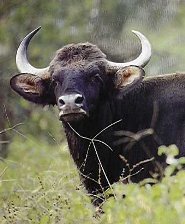
 The Gaur (Bos frontalis) is a big relative of the cow, being a bovine itself, and is the largest known wild cattle on the planet – in fact they are bigger than bison, water buffalo, and the Cape buffalo. They are found in south Asia, and are particularly vulnerable. In fact, they are listed as a threatened species, and if more is not done to prevent their population loss, they will become endangered soon. They have a high ridge on their forehead between their horns and back has a ridge that is marked and raised with their body length being around 250 to 360cm (8-12 feet), and they typically stand as high as 220cm (7.2 feet) although the males typically are taller than females. They have big ears, smallish tails which average 70 to 100cm (28-40 inches), and a noted pattern of hair loss on their backs in males as they age. As adults they are very dark in color, being a dark brown to black – and darkening with age. Their heads from the eyes to the neck is an ashen gray and sometimes lighter, while their muzzle is a pale color. Their legs, from the knees down, are white. Adolescent and young Gaurs are usually lighter and paler in tone, and gradually darken with aging.
As they are the heaviest, and most powerful of all wild cattle, they hold a special place as the apex bovine, and their ecological role provides an important food source for only one large apex predator which is known to have killed a healthy adult – that being a tiger. Even then, there are more cases of tigers being killed by Gaurs, than Gaurs being killed by tigers. The males of the species are extremely muscular, and powerful – able to generate enough power to be deadly to predators, humans, and other domestic cattle that are unfortunate enough to provoke them. They live in herds of around 30-50 members, and they gestate for around 280 days. Herds are typically led by the oldest female, while males are mostly nomads that wander in search of females. In the herd the young are typically protected fiercely, as the large adult females will form a circle with heads and horns facing outward to protect the young from possible attack by tigers. An unusual behavior observed when a tiger was sensed by a herd, and they formed in an ancient human military tactic called a phalanx, and drove it off in a steady march toward the unfortunate tiger while lined up.
The Gaur’s Binomial Name is Bos gaurus, and there are four subspecies: Bos gaurus laosiensis which is found in Myanmar to China, Bos gaurus gaurus (seen in the picture) which is the type species that is found in India, Bos gaurus hubbacki which is found in Thailand and Malaysia and is the smallest, and finally Bos gaurus frontalis which is the domestic Gaur, and is likely a hybrid between cattle and Gaur. Gaur belong to the Genus Bos, of which all wild and domestic cattle belong. Bos belongs to the Subfamily Bovinae, which include the antelope, water buffalos, Voar, Saola, Bushback, and many more. Bovinae belongs to the Family Bovidae, of which all Bovines belong, including goats, impalas, chirus, gazelles, and many more. Bovidae belongs to the Infraorder Pecora which is most of the ruminants, such as giraffes, deer, musk deer, and more. Pecora belongs to the Suborder of Ruminantia, of which all ruminants belong, which includes the mouse deer. Ruminantia belongs to the Order Artiodactyla, of which all the even toed ungulates belong. Artiodactyla belongs to Laurasiatheria, of which many mammals are members including carnivores and bats. This of course belongs to the Infraclass Eutheria, or all the placental mammals, and this belongs to the Subclass Theria, which is all the mammals with the exception of the Monotremes.
Interesting Fact: The Gaur was cloned in 2001, and became the first cloned endangered species, unfortunately the healthy calf died due to unrelated causes (dysentery) two days later.
Picture is of the Indian Gaur, by LRBurdak licensed under GFDL
Keywords: white
The Gaur, indian bison is listed as Vulnerable (VU), considered to be facing a high risk of extinction in the wild, on the IUCN Red List of Threatened Species
Some facts about the
Gaur
Adult weight : 825 kg (1815 lbs)
Maximum longevity : 26 years
Female maturity :590 days
Male maturity : 550 days
Gestation : 275 days
Weaning : 137 days
Litter size : 1
Litters per year : 1
Interval between litters : 634 days
Weight at birth : 23 kg (50.6 lbs)

Custom Search