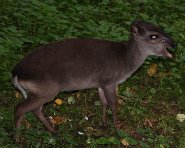
 The Blue Duiker (Cephalophus monticola) is a smallish duiker residing mostly in Central and Southern Africa. Standing up to 35 centimeters with a weight of up to 4 kilograms, the blue duiker is an omnivore that feeds on the floor of the forest. The animal's tendency to inhabit rain forests makes it prey for the Crowned Eagle, becoming an easy target as it scours the forest floor for fruit, leaves, eggs and bugs. The solitary, nocturnal habits of the blue duiker are both an asset and a disadvantage in this regard, lacking the protection of a herd but doing most of its feeding in the low visibility of night.
Blue Duikers are distinguished from other duikers by the slight blue shine of their coat. Although not overtly blue in appearance, the tinge is enough to warrant distinguishing from others of the same family. Conical horns are present on the forehead of the male animal, though females won't always bare them. Resembling a small deer, duikers are more easily found than many other small mammals. Duikers are common throughout Africa, and the Blue Duiker is no exception. In certain areas of Gabon, the population density of the Blue Duiker can reach upwards of 80 animals in any square kilometer. Maintaining territorial bounds in such a dense population can be tense, and the Blue Duiker is particularly sensitive to its domain.
The canopy of the rainforest that provides so many creatures with shelter is the main source of protection and sustenance for the Blue Duiker population. Although nowhere near threatened or endangered, deforestation could eventually have a negative impact on the Blue Duiker population. The animal’s refusal to associate with others of the breed - aside from the period of parenthood and traveling as mating pairs - will help to prolong their survival by avoiding the massive population losses common with herds.
Picture of the blue duiker by Hartmut Inerle, Zoo Krefeld, licensed under Creative Commons Attribution-Share Alike 3.0 Unported license.
Keywords: blue , brown , white , horn , nocturnal , hooves
The Blue duiker is listed as Least Concern (LR/lc), lowest risk. Does not qualify for a more at risk category. Widespread and abundant taxa are included in this category, on the IUCN Red List of Threatened Species
Countries
Angola, Benin, Burundi, Cameroon, Central African Republic, Congo, Democratic Republic of the, Congo, Republic of the, Cote d'Ivoire, Equatorial Guinea, Ethiopia, Gabon, Kenya, Lesotho, Malawi, Mozambique, Nigeria, Rwanda, Sierra Leone, South Africa, Sudan, Swaziland, Tanzania, Uganda, Zambia and ZimbabweSome facts about the
Blue duiker
Adult weight : 6.25 kg (13.75 lbs)
Maximum longevity : 16 years
Female maturity :487 days
Male maturity : 685 days
Gestation : 193 days
Litter size : 1
Interval between litters : 265 days
Weight at birth : 0.8 kg (1.76 lbs)
Basal metabolic rate : 10 W
Body mass : 4.2 kg (9.24 lbs)

Custom Search