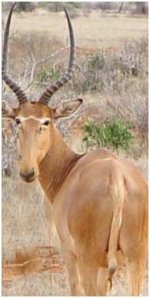
Hirola or Hunter's hartebeest


StumbleUpon Toolbar Stumble this page!

Animal of the Day
Subscribe to the
animal of the day
Enter your Email


Powered by FeedBlitz

Top articles


Animals living in the water
Swim with manatees - harmful or helpful?

Pictures of the hirola or Hunter's hartebeest are copyrighted
by their owners
Some facts about the
Hirola

Adult weight : 159 kg (349.8 lbs)

Gestation : 283 days

Litter size : 1

Weight at birth : 8.35 kg (18.37 lbs)

Source: AnAge, licensed under CC

Hirola or Hunter's hartebeest

Order : Artiodactyla
Family : Bovidae
Subfamily : Alcelaphinae
Species : Damaliscus hunteri


HirolaThe average mass of a Hirola (Damaliscus hunteri) ranges from 80 to 120 kg, with an average shoulder dimension of 1 meter. As of the moment, experts contend that there are less than four hundred individuals on the face of the planet.

Competing with domestic cattle is believed to be the fundamental reason for the Hirola's dwindling numbers, but there are still other causes. Poaching is one, which is the reason for so many species going under the "near-extinction" roster. As far as the US is concerned, only a single Hirola exists in capture, that is, a female at Texas' Gladys Porter Zoo.

For those that are remaining, the Hirola is confined to territories in Somalia and parts of Kenya, but it has been introduced too at the Tsavo National Park. Not to put too fine a print on it, but this antelope is now Africa's most endangered antelope, and their numbers have both shockingly and sadly gone down to a very small number, a process mankind has witnessed for the past three decades.

These antelopes could be found on grassy, arid areas. They are diurnal (active on daytime), and during nighttime, they graze. Typical herds would have anything from 2 to 40 females, under the control (and we can safely guess, defense) of a male. During fights, a male would go down on its knees, but when it is wrestling with another, they are up on all legs.

Picture of the hirola licensed under GFDL

Facts about the hirola or Hunter's hartebeest

More often, however, the hirola is placed in the subgenus Beatragus, which both allies it with the topi and accentuates its uniqueness.

Conservation Status Hunter's hartebeest is classified as critically endangered by the IUCN (1996), with fewer than 400 living individuals.

Currently, the Hirola is endemic to Kenya.

The hirola is crepuscular and feeds mostly on grasses. (Full text)

The hunter's hartebeest is an African antelope that comes from Kenya near the border of Somalia. (Full text)

Coke's Hartebeest are quite common in Tsavo East but the Hirola is a very similar looking animal which has longer straight horns, but still with the hump on the back. (Full text)

Practical conservation in action The hirola is Africa's most endangered antelope. (Full text)

One of the world’s rarest mammals and onetime thought to be extinct, the Hirola is found in the seasonally arid grassy plains of Kenya and Somalia. (Full text)

An antelope related to the hartebeests, Damaliscus hunteri, is known as Hunter's hartebeest but is more properly called a damalisk. (Full text)

The Hunter's Hartebeest is thought to be an evolutionary link between true hartebeests and the sassabies (Damaliscus). (Full text)

hartebeest The hunter's hartebeest is an African antelope that comes from Kenya near the border of Somalia. (Full text)

More often, however, the hirola is placed in the subgenus Beatragus, which both allies it with the topi and accentuates its uniqueness. (Full text)

org/) The Hirola Project The hirola is Africa's most endangered antelope. (Full text)

The unusual Hunter's hartebeest is guarded in the Arawale National Reserve. (Full text)

21 (January–March 1998) Hirola genetic study Hunter's hartebeest, or the hirola (Damaliscus hunteri), is one of the most endangered of all antelope species. (Full text)

Google
Contact Us | ©2008 TheWebsiteOfEverything.com | Pictures and facts about the Hirola or Hunter's hartebeest