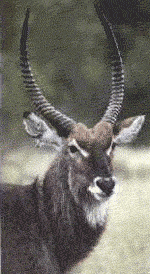
 Hearing the word "antelope" we are spontaneously thinking of fast and slender ungulates inhabiting the African arid regions. But there are several species, which differ from this image of an "antelope". The Waterbuck (Kobus ellipsiprymnus) is one of them. Strictly speaking "antelope" isn't an exact zoological term for a certain group of animals anyway. It's more a collective name for all horned even-toed ungulates excluding bovines, sheep and goats, not taking into account the real relationships. Nevertheless it is useful to keep such an established term, and so the Waterbuck is also known as "Hirschantilope" in German, which can be translated as "Deer antelope". The Waterbuck's physique actually resembles the one of a deer and its size is similar to the size of a Red deer: Waterbucks reach lengths of more than 200 cm and weights of 250 kg - females are just a little smaller than males. But the horns, which are exclusively worn by the males, are not at all alike the antlers of deers; they are up to 100 cm long and are slightly curved to the front. The Waterbuck's hair is long and straggly and of different brownish shades, depending on the population's distribution. It is permanently greased with an oily, water-repellent secretion of the perspiratory glands.
Keywords: brown , white , horn , diurnal
The Waterbuck is listed as Conservation Dependent (LR/cd), the focus of a continuing taxon-specific or habitat-specific conservation programme targeted towards the taxon in question, the cessation of which would result in the taxon qualifying for one of the threatened categories below within a period of five years, on the IUCN Red List of Threatened Species
Countries
Angola, Benin, Botswana, Burkina Faso, Burundi, Cameroon, Central African Republic, Chad, Congo, Democratic Republic of the, Congo, Republic of the, Cote d'Ivoire, Ethiopia, Gabon, Gambia, The, Ghana, Guinea, GuineaBissau, Kenya, Malawi, Mali, Mozambique, Namibia, Niger, Nigeria, Rwanda, Senegal, Sierra Leone, Somalia, South Africa, Sudan, Swaziland, Tanzania, Togo, Uganda, Zambia and ZimbabweWaterbuck habitats
Dry savanna, Grassland, Savanna, Shrubland, Subtropical / Tropical Dry Grassland and Subtropical / Tropical Dry ShrublandSome facts about the
Waterbuck
Adult weight : 175.333 kg (385.7326 lbs)
Maximum longevity : 30 years
Female maturity :771 days
Gestation : 264 days
Weaning : 213 days
Litter size : 1
Litters per year : 1
Interval between litters : 365 days
Weight at birth : 9 kg (19.8 lbs)
Basal metabolic rate : 149 W
Body mass : 100 kg (220 lbs)

Custom Search