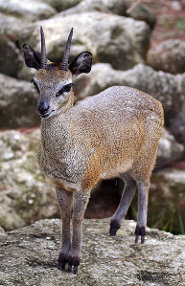
 The klipspringer (Oreotragus oreotragus) is an amazing little hooved mammal who walks on the tips of its hooves and can race and jump across rocky terrain. Appearing as tiny antelopes, they make their homes on rocky terrains and are known for their amazing agility and grace on the rocks. Incredibly talented at balancing, these little acrobats can bring all four feet into one spot and balance themselves on an area no larger than a silver dollar.
Their technical name is the oreotragus oreotragus and they typically stay very small. They typically only reach 58 cm or 22 inches in height at the shoulder. Their weight will also stay low at a lightweight 18 kg or 40 pounds.
This stocky little animal is extremely powerful and agile. The horns on the male are actually shorter than the ears at only 4 to 6 inches long. The coat if a dark brown flecked throughout with black spots, allowing it to blend perfectly with the rocks it spends so much time on. Evenly spaced eyes are placed above a nose that is wedge-shaped and short.
These delicate looking animals are found through much of southwester Africa from the Cape at the south to Abyssinia and eastern Africa. Within those regions, the toe-prancing light-footed herbivores are commonly found in the kopjes of the savannas. Kopjes are those rocky prominences that jut out of the landscape in the plains.
Unlike most other animals, klipspringers are monogamous. They typically choose a mate and will stay close to that individual throughout life. The males of the species are highly territorial and don’t like to share their terrain. One male will typically claim areas ranging from five to ten acres in size.
The klipspringer is known for some rather rare abilities. When standing, it will bring all four legs together and balance on them in one spot. It is also the only horned ungulate that can lie down with its front legs stretching out together in front of it.
The oreotragus oreotragus has some unique sounds it makes. When issuing an alarm to others it makes a loud whistling sound through the nose. Roaring sounds can be made when they are scared or in distress and the males are known for humming softly when mating.
Kiplingers dine on succulents and other rock plants. Perfectly suited to life on the rocky terrain, they do not require drinking water but can absorb the liquid thy need through their diet of succulents or by licking the morning dew from their rocky homes.
Predators of the Kiplinger include both leopards, hyenas, snakes and caracals on the ground and eagles from above. Their small size makes them a tempting meal for many carnivores, although their swift feet and affinity for slippery rocks can help keep them out of danger. This little rock dancer is not currently endangered and is considered to be at low-risk.
Picture of the Klipspringer by Munificent, licensed under the Creative Commons Attribution-Share Alike 3.0 Unported license.
The Klipspringer is listed as Conservation Dependent (LR/cd), the focus of a continuing taxon-specific or habitat-specific conservation programme targeted towards the taxon in question, the cessation of which would result in the taxon qualifying for one of the threatened categories below within a period of five years, on the IUCN Red List of Threatened Species
Countries
Angola, Botswana, Burundi, Central African Republic, Congo, Democratic Republic of the, Djibouti, Eritrea, Ethiopia, Kenya, Lesotho, Malawi, Mozambique, Namibia, Nigeria, Rwanda, Somalia, South Africa, Sudan, Swaziland, Tanzania, Uganda, Zambia and ZimbabweKlipspringer habitats
Desert, Dry savanna, Grassland, Hot Desert, Savanna, Shrubland, Subtropical / Tropical Dry Grassland and Subtropical / Tropical Dry ShrublandSome facts about the
Klipspringer
Adult weight : 12 kg (26.4 lbs)
Maximum longevity : 26 years
Female maturity :365 days
Male maturity : 365 days
Gestation : 196 days
Weaning : 137 days
Litter size : 1
Litters per year : 1
Interval between litters : 365 days
Weight at birth : 1.13 kg (2.486 lbs)

Custom Search