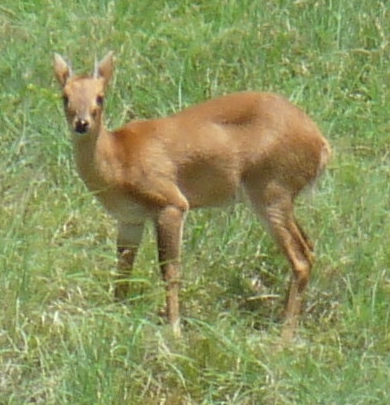
Four-horned antelope
Order : Artiodactyla
Family : Bovidae
Subfamily : Bovinae
Species : Tetracerus quadricornis
The Chousingha, four-horned antelope is listed as Vulnerable (VU), considered to be facing a high risk of extinction in the wild, on the IUCN Red List of Threatened Species
Namings for the fourhorned antelope
A young / baby of a fourhorned antelope is called a 'calf'. The females are called 'doe' and males 'buck'. A fourhorned antelope group is called a 'herd or cluster'.Four-horned antelope habitats
Forest, Shrubland, Subtropical / Tropical Dry forest, Subtropical / Tropical Dry Shrubland and Subtropical / Tropical Moist LowlandSome facts about the
Four-horned antelope
Adult weight : 19 kg (41.8 lbs)
Maximum longevity : 17 years
Female maturity :365 days
Gestation : 212 days
Litter size : 2
Interval between litters : 316 days
Weight at birth : 1.044 kg (2.2968 lbs)
Facts about the four-horned antelope
The "four-horned" antelope is called the "Tetracerus (Latin for "four-horned") quadricornis (Greek for "four-horned"), which probably indicates how amazed the biologist who discovered and named the animal was at the four horns.
The 'Chowsingha' (four horned antelope) is commonly found at Sariska; exclusively Indian, it is the world's only wild creature, which has two pairs of horns.
The Four-horned Antelope is a [CITIES-listed Endangered Species]
The four-horned antelope is dependent on water and rarely strays far from a water source.
The four-horned antelope is rarely found far from a water, and must drink regularly in order to survive.
The Four-horned Antelope or Chowsingha (Tetracerus quadricornis) is rare and inhabits the hilly, dry forest and the Indian Gazelle or Chinkara (Gazella gazella) is found in the peripheries of the Park in open and scrub country.
The world's only wild creature with two pair of horns, Chowsingha ( Four horned antelope) is found in Sariska.
This four-horned antelope is rarely found far from a water, and must drink regularly in order to survive.
Geographic Range Tetracerus quadricornis is found only in India and Nepal (Nowak, 1999; Walker, 1995). (Full text)
Habitat Four-horned antelopes are found primarily in wooded areas in India. (Full text)
Quadri- (Latin) prefix meaning four; cornu (Latin) the horn of an animal: therefore Tetracerus quadricornis is a four-horned four-horn - an appropriate name for this unique ungulate. (Full text)
The four-horned antelope is rarely found far from a water, and must drink regularly in order to survive. (Full text)
More animals beginning with F