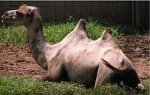
Bactrian camel
Order : Artiodactyla
Family : Camelidae
Species : Camelus bactrianus
The Bactrian camel (Camelus bactrianus) is native to the steppes of eastern Asia. As we all know a camel has two lumbs, and a dromedary has one. Contrary to popular belief, the lumbs are not used to store water for travelling in dry areas. From Wikipedia: "Camels are well known for their humps. They do not store water in them as is commonly believed. Their humps are a reservoir of fatty tissue, while water is stored in their blood. However, when this tissue is metabolised, it is not only a source of energy, but yields through reaction with oxygen from the air 1111 g of water per 1000 g of fat. This allows them to survive without water for about two weeks, and without food for up to a month."
Compared to the dromedary, it is built for a more harsh life in the desert, the dromedary being taller an faster. A Bactrian camel can drink as much as 120 (!) litres of water at a time... The wild Bactrian camel population was first discovered by Przewalski, the same man who gave his name to the Przewalski horse.
Thanks to Thomas for pointing out that Camels do not store water in their humps.
Bactrian camel photographed by Jcwf, licensed under GNU Free Documentation License
The Bactrian camel, wild bactrian camel is listed as Critically Endangered (CR), facing an extremely high risk of extinction in the wild, on the IUCN Red List of Threatened Species
Namings for the Bactrian camel
A young / baby of a Bactrian camel is called a 'calf'. The females are called 'cow' and males 'bull'. A Bactrian camel group is called a 'flock'.
Facts about the Bactrian camel
Conservation The wild Bactrian camel is an endangered animal.
Habitat & range: Bactrian camels are found in the arid lands of the Gobi Desert and nearby dry steppe (grassland) in China and Mongolia.
The humps form a kind of "saddle" on the camel's back Vital Statistics Bactrian camels are up to ten feet in length and six to eight feet in height.
Usually, the milk yield is about three pounds a day after a calf has suckled, and the carcass yield of a Bactrian Camel is about 30 percent. (Full text)
Camelus bactrianus Linnaeus, 1758 The Bactrian Camel (Camelus bactrianus) is a large even-toed ungulate native to the steppes of eastern Asia. (Full text)
Cud-chewing mammal of the family Camelidae, the order Artiodactyla, of which there are two species, the Camelus dromedarius central in North Africa and the Middle East, while the other Camelus bactrianus is central to more eastern parts of Asia, and will not be dealt with here. (Full text)
The Bactrian Camel is a odd looking (Full text)
Bactrian camels are targeted by hunters seeking food, sport, or merely to protect their own domestic animals which compete with the camels for grazing space. (Full text)
Three bactrian camels are silhouetted at dusk Giclee Print, By George F. (Full text)
*** The wild Bactrian camel is one of the world's rarest mammals. (Full text)
White Bactrian camels are even more scarce than white Dromedary camels, and these white baby camels will bring a high price. (Full text)
Bactrian camels are well suited for cold claimant and rugged mountain train. (Full text)
As pack animals Bactrian Camels are unsurpassed. (Full text)
Bactrian Camels are over 7 feet (2 m) tall at the hump and weigh in excess of 1,600 pounds (725 kg). (Full text)
Printouts The Bactrian Camel, Camelus bactrianus, is a two-humped camel that lives in the rocky Gobi desert and the grasslands (steppes) of Asia; these habitats get both very hot and very cold. (Full text)
Range - The Bactrian Camel is an animal that lives in Asia, Northern Africa, China, and Mongolia. (Full text)
The Bactrian camel is also heavier and has a longer coat. (Full text)
The Bactrian Camel (Camelus bactrianus) is a large even-toed ungulate native to the steppes of eastern Asia. (Full text)
The male Bactrian camel is not very sensitive to temperature, pressure and lubrication inside the AV, but since copulation can be a lengthy process, taking anything from 3 - 25 minutes, and since the temperature during the winter rutting-season in China is low (as low as -20oC), the temperature inside the AV should be 40 - 41oC. (Full text)
The Bactrian Camel ( (Camelus bactrianus) is from Asia. (Full text)
Other descriptions of Bactrian Camel Bactrian Camel Conservation status: Critical Scientific classification Kingdom: Animalia Phylum: Chordata Class: Mammalia Order: Artiodactyla Family: Camelidae Genus: Camelus Species: bactrianus Binomial name Camelus bactrianus Linnaeus, 1758 The Bactrian Camel (Camelus bactrianus) is a large even-toed ungulate native to the steppes of eastern Asia. (Full text)
Other descriptions of Camelus bactrianus Bactrian Camel Conservation status: Critical Scientific classification Kingdom: Animalia Phylum: Chordata Class: Mammalia Order: Artiodactyla Family: Camelidae Genus: Camelus Species: bactrianus Binomial name Camelus bactrianus Linnaeus, 1758 The Bactrian Camel (Camelus bactrianus) is a large even_toed ungulate native to the steppes of eastern Asia. (Full text)
Bactrian CamelCamelus bactrianus Also Called: Two-humped camel or Ship of the desertThe most distinctive feature of the bactrian camel is its two humps. (Full text)
Bactrian camels are usually a beige color with hair that ranges from short to long depending on the season. (Full text)
The bactrian camel is the two humped camel. (Full text)
Conservation Status While domesticated camels number over 2 million, the wild Bactrian camel is classified as endangered by the IUCN (1996), (Full text)
(additional references)Top Crosswords: Camelus BactrianusNon-English Usage: "Camelus Bactrianus" is also a word in the following language with English translations in parentheses. (Full text)
1. Bactrian camel, Camelus bactrianus -- (two-humped camel of the cold deserts of central Asia)Bactrian camel
Camelus bactrianus
(Source WordNet)


