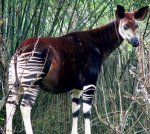
| Pictures of the okapi are copyrighted by their owners |
|
Some facts about the
Okapi
Adult weight : 225 kg (495 lbs)
Maximum longevity : 34 years
Female maturity :578 days
Male maturity : 790 days
Gestation : 458 days
Weaning : 194 days
Litter size : 1
Litters per year : 1
Weight at birth : 16 kg (35.2 lbs)
Weight at weaning : 77 kg (169.4 lbs)
Okapi
Order : Artiodactyla
Family : Giraffidae
Species : Okapia johnstoni
The Okapi (Okapia johnstoni), is a relative of the giraffe and because of the stripes on its leg bears some resemblance to a zebra. This was the reason for some people to believe it was a cross-breed, but it really isn't. It lives in the forest in the Democratic republic of Congo, where it is threatened by deforestation and and poaching. The "zebra markings" are believed to function as a beacon for the young to follow their mother in the dense forests. Did you know that the okapi is one of the few mammals that can lick its own ears?
The Okapi is listed as Near Threatened (Near Threatened (NT), is close to qualifying for or is likely to qualify for a threatened category in the near future, or LR/nt), is close to qualifying for or is likely to qualify for a threatened category in the near future, on the IUCN Red List of Threatened Species
Facts about the okapi
Description: The okapi is a dark,
- information okapi is financial statement template
- knife okapi is comparison financial ratio
Sclater, 1901) </table> The Okapi (Okapia johnstoni) is the closest living relative of the Giraffe.
The okapi is related to the giraffe.
Sclater, 1901) The Okapi (Okapia johnstoni) is the closest living relative of the Giraffe. (Full text)
Okapis are between 4 -5 feet (1. (Full text)
Upon observing the white and black stripes that cover their legs and backside, one might think that Okapis are related to the Zebra. (Full text)
Named for Johnston, Okapia johnstoni is a heavy-bodied animal with a coat of reddish chestnut, yellowish-white cheeks, and thighs ringed with alternating stripes of cream and purplish black. (Full text)
Description Upon observing the white and black stripes that cover their legs and backside, one might think that Okapis are related to the Zebra. (Full text)
Okapis are irregularly distributed over their range, preferring some kinds of forest but avoiding others. (Full text)
The neck is shorter than that of a giraffe, and the okapi is much smaller than the giraffe. (Full text)
Unknown until 1901, Okapis are still very rare in zoos. (Full text)
The Okapis Are Home (Full text)
The okapi (Okapia johnstoni) is the closest living relative of the giraffe. (Full text)
Okapis are closely related to giraffes, but many people think they must be part zebra. (Full text)
- giraffe okapi is financial personal report (Full text)
The okapi (Okapia johnstoni) is the closest living relative of the Giraffe. (Full text)
Despite its patchy distribution, Okapia johnstoni is common in much of its current range and is therefore not listed as a threatened species by international agreement. (Full text)
Habitat Okapis are found only in the tropical rainforests of (Full text)
6 feet (80 centimeters) tall, about 35 pounds (16 kilograms) Age of maturity: 2 to 3 years Conservation status: lower risk Fun Facts Female okapis are just slightly taller than male okapis but weigh 55 to 110 pounds (25 to 50 kilograms) more. (Full text)
1. oka -- (a Turkish unit of weight equal to about 2.75 pounds)oka
2. oka -- (a Turkish liquid unit equal to 1.3 pints)
oka
3. oca, oka, Oxalis tuberosa, Oxalis crenata -- (South American wood sorrel cultivated for its edible tubers)
oca
oka
Oxalis tuberosa
Oxalis crenata
(Source WordNet)