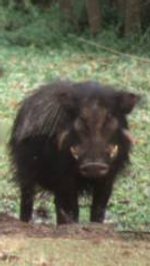
 The Giant forest hog (Hylochoerus meinertzhageni) is the largest pig of the 16 pig species (family Suidae) in the world. The length of adults ranges from 130-210 cm, their height from 75-110 cm and they can weigh between 180-275 kg. They live in scattered populations in the rainforests of West and Central Africa. They are shy, nocturnal creatures, which feed on grass and do not dig with their snouts for food like other wild pigs. 'Wallowing', rolling through the mud, is a favourite activity of them. The male is responsible for defending the group and does so very aggressively. Giant forest hogs, like other pigs practice 'coprophagy', which means they consume feces of other animals, because they contain amounts of semi-digested food. Their main predators are the leopard and the hyena.
 Interesting fact: In the Congo, eating a giant forest hog is believed to bring misfortune.
Picture of the Giant forest hog by S. Fimpel, licensed under GFDL
The Giant forest hog is listed as Least Concern (LR/lc), lowest risk. Does not qualify for a more at risk category. Widespread and abundant taxa are included in this category, on the IUCN Red List of Threatened Species
Namings for the giant forest hog
The females are called 'sow' and males 'boar'. A giant forest hog group is called a 'drift or herd'.Countries
Cameroon, Central African Republic, Congo, Democratic Republic of the, Congo, Republic of the, Cote d'Ivoire, Ethiopia, Gabon, Ghana, Guinea, Kenya, Liberia, Nigeria, Rwanda, Sierra Leone, Sudan, Tanzania and UgandaSome facts about the
Giant forest hog
Adult weight : 202.5 kg (445.5 lbs)
Female maturity :365 days
Male maturity : 517 days
Gestation : 132 days
Weaning : 68 days
Litter size : 5
Litters per year : 1
Interval between litters : 365 days
Weight at birth : 1.25 kg (2.75 lbs)

Custom Search