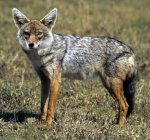
Original source: Transferred from en.wikipedia; transferred to Commons by User:Masur using CommonsHelper.
Author: Original uploader was Profberger at en.wikipedia
Permission: GNU Free Documentation License
Some facts about the
Golden jackal
Adult weight : 11 kg (24.2 lbs)
Maximum longevity : 19 years
Female maturity :334 days
Male maturity : 334 days
Gestation : 63 days
Weaning : 75 days
Litter size : 3
Litters per year : 1
Interval between litters : 365 days
Weight at birth : 0.208 kg (0.4576 lbs)
Golden jackal
Order : Carnivora
Family : Canidae
Species : Canis aureus
The Golden Jackal (Canis aureus) is also called Common or Asiatic Jackal. They live from North and East Africa, Southeastern Europe and South Asia to Burma and prefer dry open lands. They are strictly monogamous and live in mating pairs and forage and hunt together, because this is much more successful. Golden Jackals scavenge by following lions for the leftovers of a kill. They are sometimes hunted for their fur, but are not threatened.
The Asiatic jackal, common jackal, golden jackal is listed as Least Concern. Does not qualify for a more at risk category. Widespread and abundant taxa are included in this category, on the IUCN Red List of Threatened Species
Namings for the golden jackal
A young / baby of a golden jackal is called a 'pup'. A golden jackal group is called a 'pack'.Countries
Afghanistan, Albania, Algeria, Austria, Bahrain, Bhutan, Bosnia and Herzegovina, Bulgaria, Burma, Central African Republic, Croatia, Djibouti, Egypt, Eritrea, Ethiopia, Greece, India, Iran, Iraq, Israel, Italy, Jordan, Kenya, Kuwait, Lebanon, Libya, Mali, Mauritania, Morocco, Nepal, Niger, Nigeria, Oman, Pakistan, Qatar, Saudi Arabia, Senegal, Slovakia, Slovenia, Somalia, Sri Lanka, Sudan, Syria, Tanzania, Thailand, Tunisia, Turkey, Turkmenistan, United Arab Emirates, Vietnam, Western Sahara and YemenHabitats
Arable Land, Artificial / Terrestrial, Dry savanna, Forest, Grassland, Moist savanna, Pastureland, Savanna, Shrubland, Subtropical / Tropical Dry forest, Subtropical / Tropical Dry Grassland, Subtropical / Tropical Dry Shrubland, Subtropical / Tropical Moist Lowland, Subtropical / Tropical Moist Montane and Urban Areas
Facts about the golden jackal
Golden Jackal The Golden Jackal is a
Golden jackals are the only medium-to-large mammal to show such a rapid decline
The common species of Southern Asia (Canis aureus) is yellowish gray, varied with brown on the shoulders, haunches, and
The golden jackal (Canis aureus) is common from northern Africa to southeastern Europe and India.
The golden jackal is a fast, efficient hunter over grasslands and bush.
The golden jackal is shorter and stockier than the other two species.
Pileated Gibbons Hylobates pileatus still sing in the tracts of evergreen forest, Asiatic Jackal Canis aureus is common, Dhole Cuon alpinus is widespread but less common, whilst Jungle Cat Felis chaus also (Full text)
Note: The common species of Southern Asia (Canis aureus) is yellowish gray, varied with brown on the shoulders, haunches, and legs. (Full text)
On the Serengeti Plain in Northern Tanzania, golden jackals are brown-tipped yellow in the rainy season (December-January), changing to pale gold in the dry season (September-October). (Full text)
Description: The golden jackal is a uniform color between dirty yellow and red, with some black on the back. (Full text)
jackal, Canis aureus is a kind of: (Full text)
The golden jackal is somewhat shorter and stockier, and the black-backed is the most slender and upstanding, with noticeably larger ears. (Full text)
Note: The common species of Southern Asia ({Canis aureus}) is yellowish gray, varied with brown on the shoulders, (Full text)
The common species of Southern Asia (Canis aureus) is yellowish gray, varied with brown on the shoulders, haunches, and legs. (Full text)
The Golden Jackal is abundant in the Mediterranean chaparral. (Full text)
Canis aureus is a jackal. (Full text)
Golden jackals are opportunistic feeders. (Full text)
The Golden Jackal is the sole member of the family Canidae in Sri Lanka and one of the 14 species of carnivores found in the island. (Full text)
Geographic spread The golden jackal is the most widely distributed jackal species, ranging from northern Africa to south eastern Europe, the Caucasus, the Middle East, and into south Asia. (Full text)
Restricted to ceratin habitat types Living at its northern-most distibution limit, Europe's golden jackals are resticted to the most productive habitats in terms of food and shelter. (Full text)
Golden jackals are the only medium-to-large mammal to show such a rapid decline in Greece in the last three decades, and are now the country's rarest canid species. (Full text)
Golden jackals are omnivorous, eating small mammals, birds, reptiles, amphibians, mushrooms and other assorted vegetation, (Full text)
Golden jackals are better suited to the open plains but the black-backed jackal does better in the woodland edges. (Full text)
Golden jackals are a new species for me. (Full text)
Theories of where, exactly, the dog came from also vary; some claim that the dog is nothing other than a domesticated gray wolf, Canis lupus , perhaps with some other species contributing to its make up, and others claim that another species, the golden jackal, Canis aureus , is the main ancestor. (Full text)
;Canis Aureus is the Golden Jackal. (Full text)
Golden jackals are one of the few mammalian predators of flamingoes - readily rushing into shallow water to seize a bird before it can take off. (Full text)
Golden jackals are mainly carnivorous and over half their diet is made up of animal food. (Full text)
1. jackal, Canis aureus -- (Old World nocturnal canine mammal closely related to the dog; smaller than a wolf; sometimes hunts in a pack but usually singly or as a member of a pair)jackal
Canis aureus
(Source WordNet)
Submit your pet