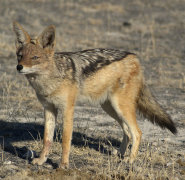
 The Black-backed jackal (Canis mesomelas), also known as the Silver-backed jackal lives in two distinct regions in Africa. One region is South Africa, Namibia, Botswana and the other Kenya, Somalia, and Ethiopia. The Black-backed jackal lives in scrubland, open woodlands, savanna, and bush. They live in pairs most of their lives and are very territorial. Black-backed jackals can team up together when hunting for antelopes or impala.
A Black-backed jackal weighs on the average about 5 to 10 kgs. They have black hair, from which their name is derived, found from the nape all the way to its tail's area. Their chest and underparts are white. The rest of their fur can go from red-brown to ginger shade. Its head is very much like a dog's, possessing a pronounced muzzle and ears that are high-pointed. The female Black-backed jackal's color is usually less pronounced.
They are mainly nocturnal, but jackals can be active both in nighttime and daytime. If it is living near the borders of human settlement, it only comes out at night. When they go after a prey, its ears are pricked. Their senses of smell and hearing are very well-developed. This particular kind of jackal is cautious when it comes to human beings, and against bigger animals, they are not aggressive, unless threatened.
Interesting fact: Because of their speed, the black-backed jackal can snatch a bite or two from under a lion's, hyena's, or leopard's nose.
Picture of the black-backed jackal by Hans Hillewaert, licensed under Attribution ShareAlike 2.5
The Black-backed jackal, chacal à chabraque, silver-backed jackal is listed as Least Concern. Does not qualify for a more at risk category. Widespread and abundant taxa are included in this category, on the IUCN Red List of Threatened Species
Namings for the blackbacked jackal
A young / baby of a blackbacked jackal is called a 'pup'. A blackbacked jackal group is called a 'pack'.Countries
Angola, Botswana, Djibouti, Eritrea, Ethiopia, Kenya, Lesotho, Mozambique, Namibia, Somalia, South Africa, Sudan, Swaziland, Tanzania, Uganda and ZimbabweBlack-backed jackal habitats
Arable Land, Artificial / Terrestrial, Coastal Sand Dunes, Desert, Dry savanna, Forest, Grassland, Hot Desert, Marine Coastal / Supratidal, Marine Intertidal, Pastureland, Sandy Shoreline and / or Beaches, Sand Bars, Spits, Etc, Savanna, Shrubland, Subtropical / Tropical Dry forest, Subtropical / Tropical Dry Grassland, Subtropical / Tropical Dry Shrubland, Subtropical / Tropical High Altitude Grassland and Subtropical / Tropical High Altitude ShrublandSome facts about the
Black-backed jackal
Adult weight : 10.25 kg (22.55 lbs)
Maximum longevity : 17 years
Female maturity :309 days
Male maturity : 251 days
Gestation : 60 days
Weaning : 60 days
Litter size : 4
Litters per year : 1
Interval between litters : 274 days
Weight at birth : 0.159 kg (0.3498 lbs)
Basal metabolic rate : 22 W
Body mass : 7.72 kg (16.984 lbs)
Temperature : 37.85 °C (100.13 °F)

Custom Search