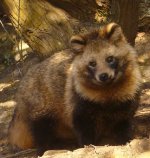
 The Raccoon Dog (Nyctereutes procyonoides) is an omnivore native to Japan, the south-east of Siberia, and Manchuria, but they have also been sighted in Europe recently. During winter they hybernate, having fattened themselves during autumn on frogs, lizards, rodents, and even birds. They supplement their diet with seeds and berries. They are threatened by humans through hunting for their fur and urbanization. Its Greek scientific name Nyctereutes procyonoides comes from nycto = night, ereutes = wanderer, procyon = raccoon, although it isn't a raccoon, it's closest living relatives being foxes. They grow to lengths of about 65 cm and can weigh up to 10 kilograms.
 Image photographed by 663highland, licensed under GFDL.
Keywords: white
The Racoon dog is listed as Least Concern. Does not qualify for a more at risk category. Widespread and abundant taxa are included in this category, on the IUCN Red List of Threatened Species
Namings for the raccoon dog
A young / baby of a raccoon dog is called a 'whelp or pup'. The females are called 'bitch' and males 'dog or sire'. A raccoon dog group is called a 'pack, litter (young), kennel, gang or legion'.Raccoon dog habitats
Arable Land, Artificial / Terrestrial, Forest, Grassland, Pastureland, Shrubland, Temperate forest, Temperate Grassland and Temperate ShrublandSome facts about the
Raccoon dog
Adult weight : 6.5 kg (14.3 lbs)
Maximum longevity : 17 years
Female maturity :304 days
Male maturity : 304 days
Gestation : 61 days
Weaning : 47 days
Litter size : 6
Litters per year : 1
Interval between litters : 365 days
Weight at birth : 0.075 kg (0.165 lbs)
Weight at weaning : 0.825 kg (1.815 lbs)

Custom Search