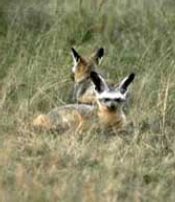
 The Bat-eared Fox (Otocyon megalotis) exists in two separate populations, one is Somalia, Sudan and Ethiopia, and the other in South African parts. These foxes stay at the grasslands and semi-deserts.
Bat-eared Foxes have grey-brown bodies, dark legs/ears, and the tails are adorned with a black mark. Its muzzle is small yet pointed, and the forehead is broad. One unusual characteristic of the Bat-eared Fox is their teeth, it possesses extra molars and a bat-eared fox could have up to fifty teeth. Their diet consists of insects, and termites comprise 50% of the diet consumption.
A Bat-eared Fox breeds just once in a year, and the cubs are born at the start of the rainy period. The Bat-eared Fox would take care of their newborns in just one place for a long time, and the gestation can last around ten weeks. There exists a high infant mortality rate, and you know why? Sadly, there are just four nipples of the female Bat-eared Fox, thus, she might be forced to kill some of the young so that at least 4 would hold better odds of surviving. When six months have passed, the kits would have grown, and she could leave the protection and nurturing.
They are monogamous, and they are capable of living in threes, that is, one male and two from the distaff side.
Picture of the Bat-eared fox by www.bourlingueurs.com
Keywords: black , nocturnal , white
The Bat-eared fox is listed as Least Concern. Does not qualify for a more at risk category. Widespread and abundant taxa are included in this category, on the IUCN Red List of Threatened Species
Namings for the bateared fox
A young / baby of a bateared fox is called a 'cub, kit or pup'. The females are called 'vixen' and males 'reynard, todd or dog'. A bateared fox group is called a 'leash or skulk'.Countries
Angola, Botswana, Ethiopia, Kenya, Mozambique, Namibia, Somalia, South Africa, Sudan, Tanzania, Zambia and ZimbabweBat-eared fox habitats
Dry savanna, Grassland, Mediterranean-type Shrubby Vegetation, Savanna, Shrubland, Subtropical / Tropical Dry Grassland and Subtropical / Tropical Dry ShrublandSome facts about the
Bat-eared fox
Adult weight : 4.15 kg (9.13 lbs)
Maximum longevity : 17 years
Female maturity :365 days
Gestation : 68 days
Weaning : 105 days
Litter size : 4
Litters per year : 2
Interval between litters : 182 days
Weight at birth : 0.122 kg (0.2684 lbs)

Custom Search