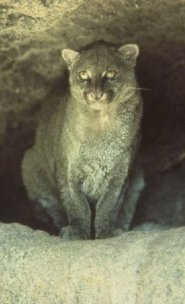
Jaguarundi


StumbleUpon Toolbar Stumble this page!

Animal of the Day
Subscribe to the
animal of the day
Enter your Email


Powered by FeedBlitz

Top articles


Animals living in the water
Swim with manatees - harmful or helpful?

Pictures of the jaguarundi are copyrighted
by their owners

Jaguarundi

Order : Carnivora
Family : Felidae
Subfamily : Felinae
Species : Herpailurus yaguarondi


JaguarundiA Jaguarundi (Herpailurus yaguarondi) may not look like a cat in the traditional sense, and some people may say that it resembles an otter more than any cat. They can be found in Central America, states of South America all the way south to Argentina and very rarely, they could be seen in Texas and also New Mexico. The Jaguarundi's color goes from dark brown to a chestnut hue. Jaguarundis have short legs, small heads and weasel-like ears. Upon being born, a Jaguarundi is spotted, but would lose these marks when they reach 4 months.

They are genetically closer to the bigger felids, their chromosome number is 38, just like the jaguar, while small felids only hold 36 chromosomes. A Jaguarundi is usually seen in lowland territories with a dense cover, like forests and scrub areas. They are more often than not found near water (running water) and it is no wonder that they are excellent hunters of fish. They catch them with their front paws, but they eat other prey too.

They hunt during the day, but evidence exists that they also do hunt during the twilight periods. They climb well, but hunt mainly on the ground.

Although it is not hunted that much for their fur, their numbers are on the way down. This is principally caused by deforestation and habitat loss, which are the major reasons why so many animals become endangered (not just the cats).

Interesting fact: It is believed that they are likely to be the descendants of the Puma (ancestral), which originates from Asia.

The Eyra cat, jaguarundi is listed as Least Concern. Does not qualify for a more at risk category. Widespread and abundant taxa are included in this category, on the IUCN Red List of Threatened Species

Facts about the jaguarundi

Accounts from Mexico suggest the Jaguarundis are good swimmers and will swim freely in the water.

Herpailurus yaguarondi The Jaguarundi (Herpailurus yaguarondi) is a medium-sized Central and South American wild cat: length 30 inches (65 cm) with 20 inches (45 cm) of tail.

Knowledge of Endangered Species is a particularly important topic to know and by researching a rare animal one learns about the threatened environment of all species and the significant difference one person can make, by reading this information, the jaguarundi is proved to be viable species which quickly dying out and must be paid serious attention to.

Of all of the New World felines, Jaguarundis are the most adaptable in its ability to occupy diverse environments.

Jaguarundis are most often found in secondary vegetation but are also found in primary habitats, and have been sighted in forests near villages. (Full text)

The Jaguarundi is one of the few species of wild cat known to exist in North America. (Full text)

The Jaguarundi (Herpailurus yaguarondi) is a medium-sized Central and South American wild cat: length 30 inches (65 cm) with 20 inches (45 cm) of tail. (Full text)

The jaguarundi is the uncommon cat being likened to a large weasel or otter - even its english name is 'otter cat'. (Full text)

Primarily terrestrial foragers, jaguarundis are known to eat rabbits, rodents, reptiles, birds (including domestic fowl), armadillos, fruit and arthropods. (Full text)

The jaguarundi is native to Central America and the northern and central countries of South America down to Argentina - it is also rarely sighted in parts of Texas and New Mexico in the southern United States. (Full text)

And although not widely known by the public, jaguarundis are prime candidates for spawning "black panther" reports. (Full text)

Herpailurus yaguarondi The Jaguarundi (Herpailurus yaguarondi) is a medium-sized Central and South American wild cat: length 30 inches with 20 inches of tail. (Full text)

Jaguarundis are a type of small cat. (Full text)

| Advanced Search New visitors: Returning BBCi members: JaguarundisJaguarundis1are a type of small cat. (Full text)

: While Jaguarundis are not native to the south-eastern United States, it is believed that a feral population exists in Florida, established from an introduced population of escaped pets in the 1940’s. (Full text)

The jaguarundi is native to forested and brushy regions, especially those near water, from South America to the southwestern United States; it is, however, very rare north of Mexico. (Full text)

POPULATION STATUS The coat of the jaguarundi is not (Full text)

The jaguarundi is one of the only felines to be devoid of markings. (Full text)

The Jaguarundi is almost diurnal and the best adapted to human changes to its habitat. (Full text)

html Jaguarundi Although the jaguarundi is part of the cat family it looks like a giant weasel in shape and habits. (Full text)

Historical accounts from Mexico suggest that Jaguarundis are also good swimmers and enter the water freely. (Full text)

1. jaguar, panther, Panthera onca, Felis onca -- (a large spotted feline of tropical America similar to the leopard; in some classifications considered a member of the genus Felis)
jaguar
panther
Panthera onca
Felis onca
(Source WordNet)

Google
Contact Us | ©2008 TheWebsiteOfEverything.com | Pictures and facts about the Jaguarundi