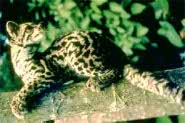
 The Margay (Leopardus wiedii) lives in the subtropical and the tropical forest regions of Central and South America. A typical individual weighs about 2.6 to 3.9 kgs. They are small, spotted cats, which bear a great deal of similarity with ocelots. The Margays' pelage is thick but soft. Its feet are quite special, it is broad with movable toes and flexible ankles. These permit them to rotate by 180 degrees! Fact is, captured members were observed and it was observed that they can jump over 18 feet (vertical) and close to 30 feet horizontally (!).
 Data regarding their reproduction has been gathered from Margays in captivity. A female Margay could breed right in the first year, and the gestation period is from 74 to 84 days. Litter size is mostly one, although two is not impossible. The Margay is acknowledged as a great climber, and its arborial capabilities have not been exaggerated. These cats can manage hindlegs reversal. The Margay could suspend itself when they are going down, akin to a squirrel's movements. They are active both in daytime and dark.
They consume a big variety of animals, and they could go for either arborial and ground mammals. Their diet consists of birds, reptiles, amphibians, fruits, etc. They are classified as basically carnivorous. In its range, to say that they are already endangered is no exaggeration. Thousands have been killed for their fur.
This cat is dependent on the protection of trees' canopy in the Central/South American territories in which they reside.
Interesting fact: In their traversing at the canopies, even if they fall, they can come out unharmed. One could stop its fall by grasping at the tree's limbs with its hind feet, then setting itself upright- a most impressive act.
Keywords: nocturnal
The Margay, tree ocelot is listed as Least Concern. Does not qualify for a more at risk category. Widespread and abundant taxa are included in this category, on the IUCN Red List of Threatened Species
Countries
Argentina, Belize, Bolivia, Brazil, Colombia, Costa Rica, Ecuador, El Salvador, Guatemala, Guyana, Honduras, Mexico, Nicaragua, Panama, Paraguay, Peru, Suriname, United States, Uruguay and VenezuelaMargay habitats
Forest, Subtropical / Tropical Dry forest, Subtropical / Tropical Moist Lowland and Subtropical / Tropical Moist MontaneSome facts about the
Margay
Adult weight : 3.667 kg (8.0674 lbs)
Maximum longevity : 24 years
Female maturity :659 days
Gestation : 81 days
Weaning : 56 days
Litter size : 2
Weight at birth : 0.167 kg (0.3674 lbs)
Weight at weaning : 0.785 kg (1.727 lbs)
Basal metabolic rate : 5 W
Body mass : 3.6 kg (7.92 lbs)

Custom Search