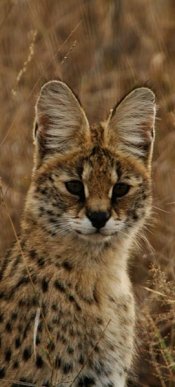
 First time I saw the Serval (Leptailurus serval) in a picture, I was amused...here was a cat that resembles all three (in varying degrees)- a leopard, a cougar and a domesticated cat. I am talking of the Serval, and they inhabit the jungles and the plains of Morocco, Algeria and South Africa. This felid has a tiny head, round ears, short tail and another animal it resembles is a lynx. The coloration of the Servals is yellow-buff, having light muzzles and underparts. Their coats have dark spots, the ears hold a big spot at the middle. The Serval living in the grass areas has a greater range than those inhabiting the forests, and all-black individuals exist, but they are principally found in Mount Kenya and Kilimanjaro.
 The Serval opts to go for food during dawn hours or dusk for that matter, and their number one tool in search of food is their strong hearing. Their diet consists of young antelopes, birds, lizards and rodents too. Sometimes they eat grass just like domestic cats.
Unlike other animals, they do not have a set breeding period, but most of the young are produced during spring. Size of the litter is 2 to 3, and these young's weight increase (by a hundred percent) by just 11 weeks.
Keywords: white
The Serval is listed as Least Concern. Does not qualify for a more at risk category. Widespread and abundant taxa are included in this category, on the IUCN Red List of Threatened Species
Countries
Algeria, Angola, Benin, Botswana, Burkina Faso, Burundi, Cameroon, Central African Republic, Chad, Congo, Democratic Republic of the, Congo, Republic of the, Cote d'Ivoire, Djibouti, Eritrea, Ethiopia, Gabon, Gambia, The, Ghana, Guinea, GuineaBissau, Kenya, Liberia, Malawi, Mali, Morocco, Mozambique, Namibia, Niger, Nigeria, Rwanda, Senegal, Sierra Leone, Somalia, South Africa, Sudan, Swaziland, Tanzania, Togo, Tunisia, Uganda, Zambia and ZimbabweServal habitats
Dry savanna, Forest, Grassland, Savanna, Shrubland, Subtropical / Tropical Dry forest, Subtropical / Tropical Dry Grassland and Subtropical / Tropical Dry ShrublandSome facts about the
Serval
Adult weight : 13.35 kg (29.37 lbs)
Maximum longevity : 22 years
Female maturity :821 days
Gestation : 70 days
Weaning : 128 days
Litter size : 3
Litters per year : 3
Interval between litters : 176 days
Weight at birth : 0.263 kg (0.5786 lbs)
Basal metabolic rate : 1 W
Body mass : 1.012 kg (2.2264 lbs)

Custom Search