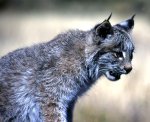
Spanish lynx


StumbleUpon Toolbar Stumble this page!

Animal of the Day
Subscribe to the
animal of the day
Enter your Email


Powered by FeedBlitz

Top articles


Animals living in the water
Swim with manatees - harmful or helpful?

Pictures of the Spanish lynx are copyrighted
by their owners
Some facts about the
Spanish lynx

Adult weight : 11 kg (24.2 lbs)

Gestation : 68 days

Litter size : 3

Source: AnAge, licensed under CC

Spanish lynx

Order : Carnivora
Family : Felidae
Subfamily : Felinae
Species : Lynx pardinus


iberian lynxThe Iberian Lynx (Lynx pardinus) or Spanish Lynx (Felis pardina) is the most threatened species of cat in the world. They live in Spain and according to a study done in 2005, the population contains no more than 100 Iberian lynxes . The male is larger than the female. They can become 13 years of age in the wild. At twilight, the Iberian lynx hunts alone on primarily rabbits, rodents, birds, reptiles and amphibians and continues during the night. They are threatened by feral dogs, poaching, habitat loss, collisions with vehicles and poisoning.

The Iberian lynx, pardel lynx, spanish lynx is listed as Critically Endangered (CR), facing an extremely high risk of extinction in the wild, on the IUCN Red List of Threatened Species
Countries
Portugal and Spain

Facts about the Spanish lynx

Location: Less successful than their close neighbors, the Spanish Lynx is now threatened with extinction in its wild habitat.

The environment of the Spanish lynx is the Mediterranean forest.

The Spanish Lynx is about the same size as the Canada lynx.

or Lynx pardinus is listed on the IUCN Red list (1996) as Critically Endangered due to C2a(i). (Full text)

The beautiful Spanish Lynx is a nocturnal cat, hunting chiefly in the twilight hours. (Full text)

The Spanish lynx is classified as Felis pardina, the bobcat as Felis rufus, the Eurasian lynx as Felis lynx, and the Canadian lynx as Felis canadensis. (Full text)

Lynx pardinus is threatened with extinction in its wild habitat. (Full text)

To some the Spanish lynx is not a valid species but a subspecies of the Eurasian lynx. (Full text)

The problem of devising a wildlife management plan for the reserve has still to be faced, and not the least of the difficulties confronting any attempt to include provision in such a plan for the Spanish lynx is the lack of reliable information (Full text)

The first breeding centre for Iberian lynx Lynx pardinus is being established at the Doñana National Park in southern Spain, home of a wild population. (Full text)

To some the Spanish lynx is not a valid species but a sub species of the Eurasian lynx, however they are generally smaller than their northern counterparts and their yellow/brown coat is lighter in colour and the spotted markings more noticeable. (Full text)

Introduction Nowadays the Iberian lynx (Lynx pardinus) is the most threatened carnivore species in Europe and one of the most endangered mammal species in the world. (Full text)

limited habitat, Lynx pardinus is considered one of the world's most endangered cat species. (Full text)

The Spanish Lynx is critically endangered and one of the rarest cat species. (Full text)

The Iberian lynx (Lynx pardinus) is fighting a desperate struggle for survival, with only about 160 of the animals left in scattered groups in Spain. (Full text)

Upgraded from Endangered to Critically Endangered, with its population dropping to less than half of the 1,200 individuals recorded in the early 1990s, the Iberian lynx ((Lynx pardinus) is close to becoming the first wild cat species to go extinct for at least 2,000 years. (Full text)

lynx Lynx pardinus is at critical risk; the Andean mountain cat Oreailurus jacobita, Bornean bay cat Catopuma badia, and Iriomote cat Felis (Full text)

Google
Contact Us | ©2008 TheWebsiteOfEverything.com | Pictures and facts about the Spanish lynx