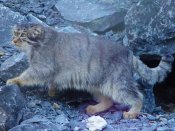
Pallas's cat


StumbleUpon Toolbar Stumble this page!

Animal of the Day
Subscribe to the
animal of the day
Enter your Email


Powered by FeedBlitz

Top articles


Animals living in the water
Swim with manatees - harmful or helpful?

Pictures of the Pallas's cat are copyrighted
by their owners

Pallas's cat

Order : Carnivora
Family : Felidae
Subfamily : Felinae
Species : Otocolobus manul


Palla's catPalla's cats (Otocolobus manul) are small animals which range in the rocky areas and deserts from Iran to China and Mongolia. The Palla's cat's appearance a bit unusual with a broad head, tiny ears, big eyes, and stocky limbs. The Palla's cat's coat is longer than any of its relatives, and it is not of uniform color. It can be light-gray or a combination of yellow and brown.

It can be extremely silent when stalking. Its ability to move stealthily makes it a good predator. It is known to sneak up on its prey even with very few plants to hide in.

This cat is both solitary and a bit mysterious, Scientists do not know much about the Palla's cat, but from all indications, they appear to be night creatures. They hunt during the night relying mostly on excellent night vision. They hunt marmots, but mice are also a significant part of their diet.

Mating happens at the early part of the year, starting with many mating calls from both the males and females. The young are born blind, with a wooly covering. These kittens become autonomous at around eight weeks, and become sexually mature at 18 months of age.

The two largest threats to Palla's cats are humans, who hunt them, and an illness, called toxomoplasmosi, which is transmitted to younger cats from eating rodents.

Interesting fact: A Palla's cat's eyes have a nictitating (blinking) membrane found at its corner. It acts as another eyelid.

The Pallas's cat is listed as Near Threatened (NT), is close to qualifying for or is likely to qualify for a threatened category in the near future, on the IUCN Red List of Threatened Species
Namings for the Pallas
A young / baby of a Pallas is called a 'kitten'. The females are called 'queen' and males 'tom '. A Pallas group is called a 'clowder, clutter, pounce, kindle (young), embarrassment (young),'.

Facts about the Pallas's cat

Pallas’s cats are about the size of a large domestic cat, and weigh about six to 11 pounds (2.

The coat of the Pallas's cat is longer than that of any other species of cat, particularly that on the undersides which is almost white, and varies in color from a light gray to a yellowish-brown and russet.

Otocolobus manul is distributed throughout Central Asia, from western Iran to western China. (Full text)

Pallas' cat (Otocolobus manul) is highly cytopathic in CrFK cells, in contrast to the chronic, noncytolytic infection established by an FIV isolate from a domestic cat (FIV-Fca). (Full text)

Long classified in the genus Felis, it is believed that Pallas's cat is closely related to F. (Full text)

Habitat: Pallas’s cats are best adapted to cold arid environments and occupy steppes, alpine (Full text)

The Pallas's cat is a soft-furred animal about the size of a house cat and is pale silvery gray or light brown in colour. (Full text)

The Pallas's cat is . (Full text)

Day 13-14: Before arriving at a small town near the DAY 15 target area we will stop for anything of interest along the way - the little-known Pallas's Cat is present at a pass where we’ll make (Full text)

NOTE to visitors: our Pallas's Cats are not on public display. (Full text)

The Pallas's cat is also known as a Manul. (Full text)

Pallas's Cats are a hefty version of a domestic house cat - approximately 6-11 pounds, stocky build, short legs. (Full text)

The Pallas' cat or manul (Otocolobus manul) is named after German naturalist Pyotr Simon Pallas (1741-1811) and is (Full text)

Otocolobus manul is relatively the same size as a large domestic cat. (Full text)

Otocolobus manul (Pallas Cat): Narrative Otocolobus manul is relatively the same size as a large domestic cat. (Full text)

The skull of Otocolobus manul is relatively convex and rounded with a short rostrum and a strongly enlarged cranium. (Full text)

The captive status of Pallas's cat is precarious: the few young reared and the occasional imports are insufficient to maintain the zoo population. (Full text)

Pallas's cat (Otocolobus manul) is a rare endangered Red Book species, indigenous to Central Asia, including deserts, steppes and highlands of Russia, Mongolia and north-west China. (Full text)

1. Oto, Otoe -- (a member of the Siouan people inhabiting the valleys of the Platte and Missouri rivers in Nebraska)
Oto
Otoe
2. Oto, Otoe -- (a dialect of the Chiwere language spoken by the Oto people)
Oto
Otoe
(Source WordNet)

Google
Contact Us | ©2008 TheWebsiteOfEverything.com | Pictures and facts about the Pallas's cat