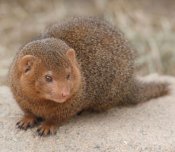
Dwarf mongoose


StumbleUpon Toolbar Stumble this page!

Animal of the Day
Subscribe to the
animal of the day
Enter your Email


Powered by FeedBlitz

Top articles


Animals living in the water
Swim with manatees - harmful or helpful?

Pictures of the dwarf mongoose are copyrighted
by their owners
Some facts about the
Dwarf mongoose

Adult weight : 0.275 kg (0.605 lbs)

Maximum longevity : 18 years

Female maturity :456 days

Gestation : 55 days

Weaning : 21 days

Litter size : 3

Litters per year : 2

Source: AnAge, licensed under CC

Dwarf mongoose

Order : Carnivora
Family : Herpestidae
Subfamily : Herpestinae
Species : Helogale parvula


Dwarf MongooseThe Dwarf Mongoose (Helogale parvula) is the smallest of all African carnivores. It is about the size of a squirrel, has a short head, sharp nose, rounded ears, and a pelage that is both red-brown and glossy. They are found in the South Savanna, Somali Masai and also in Ethiopia and Namibia.

They live around termite mounds, woodlands and wooded vegetations and their diet consists of grasshoppers, crickets, beetles, scorpions, spiders, lizards, snakes, some vegetables, fruits... The Dwarf Mongoose is diurnal, but sometimes their habits change, influenced by the weather. The Dwarf Mongoose lives with packs, and these packs "own" territories that are about 85 acres in size.

There is a breeding pair, and this is made up of the older female and male, and they monopolize breeding. The monopoly is theirs only for as long as they are dominant, which would last up to many years. Females would lead the group, it is the male's job to lookout and be aware of external threats and attacks from rival groups. The other members are the ones to care for the newborns, liberating the mother from the obligations of feeding her young. Thus, instead of feeding the young, the mother has all the time to feed and take care of herself. The newborns would leave the den after 3 weeks, and would start foraging (not alone) after a month.

Interesting fact: Somewhere in East Kenya a long time ago, a fascinating association was documented between a mongoose and 2 Bush Hornbills. The hornbills would get the rodents/insects acquired by the pack, and as a "counter-favor", they would be "guards". They would emit alarm calls when they see flying predators approaching.

Original picture by

Miika Silfverberg from Vantaa, Finland, posted on Flickr, licensed under Attribution ShareAlike 2.0

The Common dwarf mongoose, dwarf mongoose is listed as Least Concern (LR/lc), lowest risk. Does not qualify for a more at risk category. Widespread and abundant taxa are included in this category, on the IUCN Red List of Threatened Species
Namings for the dwarf mongoose
A dwarf mongoose group is called a 'mongeese or mongaggle'.

Facts about the dwarf mongoose

ffffffffffffffffffffffffffffffffffffff HABITAT ffffffffThe Dwarf mongoose is the smallest african carnivore.

However, this data suggests that the dwarf mongoose is an exception to this rule because breeding pairs in packs were generally closely related and there was no negative effect on offspring production, offspring survival or adult survival (Waser

Social Relationships The Dwarf Mongoose, Helogale parvula, is a very social

The diet of a Dwarf mongoose is mostly insects, they will also eat birds, mice, snakes, beetles, larvae and lizards.

The Dwarf Mongoose is the smallest of the mongoose family, and both males and females weigh only 350-400 gr.

The ever present troops of Banded and Dwarf Mongooses are seen daily foraging for insects on the lawns of all three Governors' Camps.

The mating system of the dwarf mongoose is classified as an obligate monogamy mainly because within a mongoose pack, the

Dwarf mongooses are much smaller, only about 20 cm long in the body. (Full text)

The dwarf mongoose is the smallest of the African species. (Full text)

Dwarf mongooses are special because they are one of the less than 3% of mammalian species reported to be monogamous. (Full text)

Wildlife Foundation] Dwarf mongooses are a special animals-- they are the smallest carnivores, they are among the extremely few number of monogamous mammalian species, and they're (Full text)

Conservation news: Dwarf mongooses are versatile, adaptable little predators that occur across much of Southern Africa. (Full text)

Dwarf Mongooses are diurnal which means most of their activities occur during the daytime. (Full text)

The dwarf mongoose is reddish brown with a short tail. (Full text)

Physical Appearance The coloration of the dwarf mongoose is variable, but it is generally a reddish-buff color with specks of brown and grey. (Full text)

The more well-known of the two species, Helogale parvula, is documented here. (Full text)

Dwarf mongooses are nomadic and are constantly on the move within their home range. (Full text)

The dwarf mongoose is the smallest African carnivore, with a size of 8 to 12 inches long. (Full text)

This is a flourishing species not yet endangered, and the exact population number of the Helogale parvula is unknown. (Full text)

Habitat: Dwarf mongooses are found in the warmer areas of East and Central Africa below 2 000 meters (6,562 feet). (Full text)

The Dwarf Mongoose is also considerably smaller. (Full text)

Google
Contact Us | ©2008 TheWebsiteOfEverything.com | Pictures and facts about the Dwarf mongoose