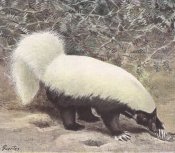
 Length: 55-60 cm (22-24 inch)
Weight: 1.9 kg (4.18 lbs)
The Common Hog-nosed skunk (Conepatus mesoleucus) or Western Hog-nosed skunk or Rooter skunk can be found in the southwestern United States (Arizona, New Mexico, Texas) and through Mexico to Nicaragua. The Common Hog-nosed skunk forages in a special way, it plows through the soil and leaves a 'plowed through' area. Common Hog-nosed skunks search for food with their noses. Their diet mainly consists of grubs and worms, which they catch using their both claws and their nose.
Ordinarily, one would be very focused when it is busy with a specific task, and as a result, it would not notice a predator at its back. The strongest facet of the defense system of the Common Hog-nosed skunk is its musk, which is very repelling. So much so that it has been studied that even rattlesnakes get repelled by the smell.
This skunk prefers grounds which are sparsely vegetated and at the same time, filled with rocks. They often construct dens from crevices of boulders or other forms of shielded places.
The fur of this skunk is rough, with a brown coloring over a dark brown layer. Big white stripe goes along the body, it has a long snout, and both front and hind feet possess five digits.
When in captivity, these skunks are alleged to be docile enough to be kept as a pet (if you can stand the smell !).
Interesting fact: It is possible to touch newborns, even in the presence of the mother, assuming the parent trusts that particular person.
Keywords: white , stripe , tail , black
The Common hog-nosed skunk, western hog-nosed skunk is listed as Least Concern (LR/lc), lowest risk. Does not qualify for a more at risk category. Widespread and abundant taxa are included in this category, on the IUCN Red List of Threatened Species
Namings for the western hognosed skunk
A young / baby of a western hognosed skunk is called a 'kit'. A western hognosed skunk group is called a 'surfeit or stink'.
Custom Search