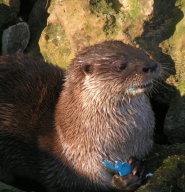
 Mass: 5 to 15 kg (11 to 33 lbs)
Length: 36 to 66 cm (14.17 to 25.98 in)
The Neotropical River Otter (Lontra longicaudis) resides in swamps, streams, lagoons and lakes in Mexico and parts of South America (especially Brazil, Bolivia, Paraguay and Uruguay). It is the most widespread of the Lontra genus.
If you have seen a North American river otter, then you could easily imagine a Neotropical River Otter, for they are quite alike in appearance. However, the Neotropical River Otter is shorter, around the mouth, the areas are white, its body is long and circular. Neotropical River Otters possess a soft wool-like undercoat that is layered with guard hairs, the latter maintains dryness to the undercoat when it is wet. Unlike seals, the Neotropical River Otter does not have an insulating layer of fats, but instead they depend on this fur for dryness and warmth.
Its head is both round and flat, ears placed low, the muzzle is just short and whisker-filled. The neck is also short, it has eyes which are widely-spaced. The best description for the nose of a Neotropical River Otter would be trapezoid-like.
The back legs are longer than the front ones, allowing them to swim adequately.
Their diet mainly consists of mollusks and fish, but they are what we call opportunistic eaters, they can also eat birds, small reptiles or mammals.
This otter has no set breeding period, and just like its relative otters, a delayed implantation prior to breeding might occur. A newborn is born fully furred, but the eyes are shut, and these would open after approximately 44 days.
Interesting fact: One marks by scent via the leaving of feces on places like bridges or logs, and you know why? Experts believe this is an advertisement of one's gender.
Picture of the Neotropical River Otter © 2006 Carla Antonini, licensed under Attribution-ShareAlike 2.5
The La plata otter, long-tailed otter, neotropical otter, neotropical river otter, south american river otter is listed as Data Deficient (DD), inadequate information to make a direct, or indirect, assessment of its risk of extinction, on the IUCN Red List of Threatened Species
Namings for the neotropical river otter
A young / baby of a neotropical river otter is called a 'pup or whelp'. A neotropical river otter group is called a 'romp, bevy, lodge, family or raft'.Countries
Argentina, Belize, Bolivia, Brazil, Colombia, Costa Rica, Ecuador, El Salvador, French Guiana, Guatemala, Guyana, Honduras, Mexico, Nicaragua, Panama, Paraguay, Peru, Suriname, Uruguay and VenezuelaNeotropical river otter habitats
Artificial / Aquatic & Marine, Artificial / Aquatic - Aquaculture Ponds, Artificial / Aquatic - Canals and Drainage Channels, Ditches, Artificial / Aquatic - Excavations (open), Artificial / Aquatic - Irrigated Land (includes irrigation channels), Artificial / Aquatic - Ponds (below 8ha), Artificial / Aquatic - Salt Exploitation Sites, Artificial / Aquatic - Seasonally Flooded Agricultural Land, Artificial / Aquatic - Wastewater Treatment Areas, Artificial / Aquatic - Water Storage Areas (over 8ha), Coastal Brackish / Saline Lagoons / Marine Lakes, Coastal Freshwater Lakes, Marine Coastal / Supratidal, Permanent Freshwater Lakes (over 8ha), Permanent Freshwater Marshes / Pools (under 8ha), Permanent Inland Deltas, Permanent Rivers / Streams / Creeks (includes waterfalls), Permanent Saline, Brackish or Alkaline Lakes, Permanent Saline, Brackish or Alkaline Marshes / Pools, Seasonal / Intermittent Freshwater Lakes (over 8ha), Seasonal / Intermittent Freshwater Marshes / Pools (under 8ha), Seasonal / Intermittent Saline, Brackish or Alkaline Lakes and Flats, Seasonal / Intermittent Saline, Brackish or Alkaline Marshes / Pools, Seasonal / Intermittent / Irregular Rivers / Streams / Creeks, Shrub Dominated Wetlands and Wetlands (inland)Some facts about the
Neotropical river otter
Adult weight : 7.5 kg (16.5 lbs)
Gestation : 57 days
Litter size : 3

Custom Search