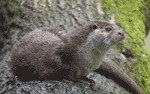
 Eurasian river otters (Lutra lutra) can be found in Europe, Asia and Northern Africa. They inhabit water habitats of all kinds: small streams, rivers, ponds and lakes. They even live at the sea shore. Otters are solitary animals doing nocturnal migrations, which may lead lots of kilometres through areas of solid ground. Their physiques are well adapted to life and hunt in water. They are quite slender, up to 70 - 90 cm long and reach weights up to 7 - 12 kg. Females are a little smaller than males. River otters hunt fish but also all other kinds of small animals living in or near the water. The amount of fish they eat varies through the seasons. It comes to 20 - 90% of their nutrition. Since there is no certain mating season in River otters, young are born throughout the year. Pregnancy lasts for 9 weeks. A litter consists of 1 - 3 pups, which stay with their mother for about one year. Eurasian river otters reach ages of 10 - 15 years.
Keywords: tail
The Common otter, eurasian otter, european otter, european river otter, old world otter is listed as Near Threatened (NT), is close to qualifying for or is likely to qualify for a threatened category in the near future, on the IUCN Red List of Threatened Species
Namings for the European otter
A young / baby of a European otter is called a 'pup or whelp'. A European otter group is called a 'romp, bevy, lodge, family or raft'.Countries
Afghanistan, Albania, Algeria, Andorra, Armenia, Austria, Azerbaijan, Belarus, Belgium, Bhutan, Bosnia and Herzegovina, Bulgaria, Burma, Cambodia, China, Croatia, Czech Republic, Denmark, Estonia, Finland, France, Georgia, Germany, Gibraltar, Greece, Hong Kong, Hungary, India, Indonesia, Iran, Iraq, Ireland, Israel, Italy, Japan, Jordan, Kazakhstan, Korea, North, Korea, South, Kyrgyzstan, Laos, Latvia, Lebanon, Liechtenstein, Lithuania, Luxembourg, Macedonia, Moldova, Mongolia, Morocco, Nepal, Netherlands, Norway, Pakistan, Poland, Portugal, Romania, Russia, San Marino, Serbia and Montenegro, Slovakia, Slovenia, Spain, Sri Lanka, Sweden, Switzerland, Syria, Taiwan, Tajikistan, Thailand, Tunisia, Turkey, Turkmenistan, Ukraine, United Kingdom, Uzbekistan and VietnamEuropean otter habitats
Alpine Wetlands (includes temporary waters from snowmelt), Artificial / Aquatic & Marine, Artificial / Aquatic - Aquaculture Ponds, Artificial / Aquatic - Canals and Drainage Channels, Ditches, Artificial / Aquatic - Irrigated Land (includes irrigation channels), Artificial / Aquatic - Ponds (below 8ha), Artificial / Aquatic - Seasonally Flooded Agricultural Land, Artificial / Aquatic - Water Storage Areas (over 8ha), Bogs, Marshes, Swamps, Fens, Peatlands, Coastal Brackish / Saline Lagoons / Marine Lakes, Coastal Freshwater Lakes, Estuaries, Forest, Freshwater Springs and Oases, Grassland, Macroalgal / Kelp, Marine Coastal / Supratidal, Marine Intertidal, Marine Neritic, Mud Flats and Salt Flats, Permanent Freshwater Lakes (over 8ha), Permanent Freshwater Marshes / Pools (under 8ha), Permanent Inland Deltas, Permanent Rivers / Streams / Creeks (includes waterfalls), Permanent Saline, Brackish or Alkaline Lakes, Permanent Saline, Brackish or Alkaline Marshes / Pools, Rocky Shoreline, Salt Marshes (Emergent Grasses), Sandy Shoreline and / or Beaches, Sand Bars, Spits, Etc, Seasonal / Intermittent Freshwater Lakes (over 8ha), Seasonal / Intermittent Freshwater Marshes / Pools (under 8ha), Seasonal / Intermittent Saline, Brackish or Alkaline Lakes and Flats, Seasonal / Intermittent Saline, Brackish or Alkaline Marshes / Pools, Seasonal / Intermittent / Irregular Rivers / Streams / Creeks, Shrub Dominated Wetlands, Shrubland, Subtropical / Tropical Dry forest, Subtropical / Tropical Mangrove Vegetation Above High Tide Level, Subtropical / Tropical Moist Lowland, Subtropical / Tropical Moist Shrubland, Subtropical / Tropical Seasonally Wet / Flooded Grassland, Subtropical / Tropical Swamp and Wetlands (inland)Some facts about the
Eurasian river otter
Adult weight : 6.75 kg (14.85 lbs)
Maximum longevity : 18 years
Female maturity :548 days
Male maturity : 548 days
Gestation : 61 days
Weaning : 55 days
Litter size : 2
Litters per year : 1
Interval between litters : 365 days
Weight at birth : 0.111 kg (0.2442 lbs)
Basal metabolic rate : 25 W
Body mass : 10 kg (22 lbs)
Temperature : 37.85 °C (100.13 °F)

Custom Search