Sable


StumbleUpon Toolbar Stumble this page!

Animal of the Day
Subscribe to the
animal of the day
Enter your Email


Powered by FeedBlitz

Top articles


Animals living in the water
Swim with manatees - harmful or helpful?

Pictures of the sable are copyrighted
by their owners
Some facts about the
Sable

Adult weight : 1.067 kg (2.3474 lbs)

Maximum longevity : 18 years

Female maturity :456 days

Male maturity : 456 days

Gestation : 30 days

Weaning : 56 days

Litter size : 3

Weight at birth : 0.03 kg (0.066 lbs)

Weight at weaning : 0.6 kg (1.32 lbs)

Source: AnAge, licensed under CC

Sable

Order : Carnivora
Family : Mustelidae
Subfamily : Mustelinae
Species : Martes zibellina


SableBody length 35-36 cm (14 to 22 inches)
Mass 1,25 kg (44 oz)

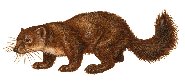
The Sable (Martes zibellina) can be found all over north Asia, and also in Siberia. They inhabit flatlands, taiga forests and mountainous grounds. They stay away from the very barren mountaintops. The Sable's winter fur is longer than in the the summer. Their fur ranges from light brown to a deep shade of the same hue. They also have a patch of fur at the throat areas, and these can be yellow or white.

Breeding period of the Sable is from June up to August, and the number of newborns on average is 2 to 3. Specifically though, it could be anything from 1 to 7. Gestation time is from 200 to 300 days, while the weaning period would be around seven weeks. Reproductive maturity would be attained in 2 or 3 years' time. It has been observed that the male Sables do ruts, or in other words, grooves on the snow. These ruts would be around 1 meter long. At places where their numbers are few, courting may involve jumping, running but in places where a lot of males are present, violent fights could occur.

In the wild, the longest recorded lifespan was 8 years, while that in captivity was 18. The Sable is diurnal, and it utilizes the senses of hearing and smell to find prey. The Sable takes refuge during bad weather especially in cases of snowstorms, or when they know they are being targeted by man. They may be dangerous in the wild, but records exist asserting that if taken away from the parent at a very tender age, they could be tamed.

Categorically, they are carnivorous, and their diet consists of chipmunks, mice, birds, fish and even squirrels. However, they are also able to subsist on cedar nuts and berries if the animal-preys can not be found. On the other side of the coin, they have their predators too, and for these, nature equipped them with claws and pointed teeth.

Interesting fact: Around 66% of the whole population of the Sable is made up of members below 2 years old.

The Sable is listed as Least Concern (LR/lc), lowest risk. Does not qualify for a more at risk category. Widespread and abundant taxa are included in this category, on the IUCN Red List of Threatened Species

Facts about the sable

"The giant sable is not extinct, but alive and well in the Cangandala National Park," the researchers said in a statement released after a two-week expedition.

Founded in 1984 by the women of SCI®, the SCI Foundation Sables are committed to continuing our outdoor heritage.

From building cabins, purchasing snowmobiles, classroom construction, and providing scholarships to Teachers and students attending AWLS, to funding new museum exhibits, the Sables are able to generate funds for these fine programs and others through raffles, sales, auctions and other fundraising activities.

Sable (Martes zibellina) is a graceful carnivore, highly valued for its fine fur which varies from brown to almost black.

Sable is said to have earned a base pay of approximately 200,000 from her second Playboy photo shoot.

html'); CallAdv(); CreateTd(2) Sable The sable, Martes zibellina, is a member of the WEASEL family, Mustelidae (see MARTEN). (Full text)

Sable is the original German Shepherd color. (Full text)

Martes zibellina is the scientific name of the true sable, though several other species are also sometimes referred to as sables. (Full text)

Whereas `Swimming Pool' is a light thriller with the theme of how books get written, `Souse le Sable' is an emotionally riveting dead serious examination of grief and its effects. (Full text)

SABLE AUSSIES Sable is the second most dominant allele in the A series and (Full text)

SABLE is an XML/SGML-based markup language for Text-to-Speech synthesis. (Full text)

--> The name SABLE is tentative. (Full text)

and 1994 Sables are defective (Full text)

Also made from flour, sugar, butter and eggs Sables are smaller than Madeleines but certainly not less satisfying. (Full text)

Black Sable is more stiff and substantial than Red Sable, but has an exceptional smoothness that leaves little stroke impression in the paint surface. (Full text)

Read about the Sable Timelines about the history of why sables are not shown in the showrings. (Full text)

Created in 1983, Sanda & Sable is a luxurious, floral fragrance. (Full text)

Martes zibellina is found throughout northern Asia through Siberia into northern China. (Full text)

SABLE The sable (Martes zibellina) is a carnivorous type of marten, similar to the pine marten but with longer legs and larger ears. (Full text)

Sables are Cockers Too (Full text)

Join Sables are Cockers Too email list (Full text)

SCI Foundation® Sables are leaders in wildlife education to preserve the hunting heritage worldwide. (Full text)

On an International level, the Sables are SCI's education (Full text)

1. sable, Martes zibellina -- (marten of North Asian forests having luxuriant dark brown fur)
sable
Martes zibellina
(Source WordNet)

Google
Contact Us | ©2008 TheWebsiteOfEverything.com | Pictures and facts about the Sable