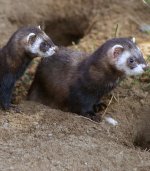
 The European Polecat (Mustela putorius), also called a 'fitch', is a mainly nocturnal, solitary creature. Their diet consists mainly on rodents and rabbits. In England, domestic ferrets have abandonned their bosses wich has led to ferret-polecat hybrids... They have also been introduced in New Zealand. Males and females differ a lot. Males can be two times the weight of a female and be a third or more longer. Polecats have a pair of anal glands that emit a strong-smelling secretion, like all mustelids. When they are excited or threatened they release some of the contents of these glands.
 Image by Malene Thyssen, licensed under GFDL.
Which zoos have them?
Saint Louis Zoological Park (United States)The European polecat is listed as Least Concern (LR/lc), lowest risk. Does not qualify for a more at risk category. Widespread and abundant taxa are included in this category, on the IUCN Red List of Threatened Species
Namings for the European polecat
A young / baby of a European polecat is called a 'kit'. The females are called 'jill' and males 'hob'. A European polecat group is called a 'chine'.Countries
Albania, Andorra, Austria, Belarus, Belgium, Bosnia and Herzegovina, Bulgaria, Croatia, Czech Republic, Denmark, Estonia, Finland, France, Germany, Gibraltar, Greece, Hungary, Italy, Latvia, Liechtenstein, Lithuania, Luxembourg, Macedonia, Moldova, Netherlands, Norway, Poland, Portugal, Romania, Russia, Serbia and Montenegro, Slovakia, Slovenia, Spain, Sweden, Switzerland, Turkey, Ukraine and United KingdomSome facts about the
European polecat
Adult weight : 0.809 kg (1.7798 lbs)
Maximum longevity : 11 years
Female maturity :312 days
Male maturity : 322 days
Gestation : 42 days
Weaning : 63 days
Litter size : 8
Litters per year : 2
Interval between litters : 140 days
Weight at birth : 0.01 kg (0.022 lbs)

Custom Search