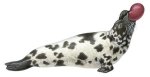
 The Hooded Seal (Cystophora cristata) is an arctic seal also known as Crested Seal. Belonging to the family Phocidae, it can only be found within North Atlantic central and western regions from Svalbard to the Gulf of St. Lawrence, throughout the northern areas of Atlantic Ocean, in parts near Labrador, and in northeastern Newfoundland down to New England. It lives on ice packs and in the Atlantic Ocean's deep waters.
 The Hooded seal is known for and named as such due to the 'hood' of the male, a unique and strange appendage that can be inflated to what resembles a red balloon. This appendage hangs from the forehead to the mouth's front and bulges out when the male is either threatened or excited. It is most distinctive, however, when it is mating. Its head is black, and its fur is silvery or grayish with a pattern of dark clouded spots. The front flippers have large claws and darker color than the body. The male is usually 2.6 meters in length and about 400 kilograms in weight while the female is smaller at 2.03 meters and about 300 kilograms on the average.
The hooded seal's most observable and most peculiar behavior still pertains to the male's 'bulge'. It balloons to about twice the size of a football when the male blows it up by closing one of its nostrils.
The hooded seal lives alone generally but converges in big groups during mating and reproductive season. This seal species has the shortest period for lactation among all mammals at four days only. Feeding mainly on deepwater fish like redfish, herring, Greenland turbot, cod, capelin, flounder, halibut, squid, octopus, shrimp, and mussels, a hooded seal can live as long as 30 to 35 years.
Image by Alessio Marrucci, licensed under GFDL
The Hooded seal is listed as Least Concern (LR/lc), lowest risk. Does not qualify for a more at risk category. Widespread and abundant taxa are included in this category, on the IUCN Red List of Threatened Species
Namings for the hooded seal
A young / baby of a hooded seal is called a 'pup'. The females are called 'cow' and males 'bull'. A hooded seal group is called a 'pod, colony, crash, flock, harem, bob, herd, rookery, team or hurd'.Some facts about the
Hooded seal
Adult weight : 405 kg (891 lbs)
Female maturity :1095 days
Male maturity : 1826 days
Gestation : 240 days
Weaning : 7 days
Litter size : 1
Litters per year : 1
Weight at birth : 18 kg (39.6 lbs)
Weight at weaning : 43.3 kg (95.26 lbs)
