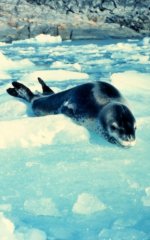
| Pictures of the leopard seal are copyrighted by their owners |
|
Leopard seal
Order : Carnivora
Family : Phocidae
Species : Hydrurga leptonyx
The Leopard Seal (Hydrurga leptonyx) is a "true seal", because they cannot "walk", rather crawl and do not have external ears. Leopard seals are large and very strong, the females can become the largest in length, reaching up to 3 and a half metres and weighing 600 kilograms (!). They hunt in the cold waters surrounding Antarctica for a variety of animals including penguins, squid, fish, and even other seals as the Crabeater Seals. I also wanted to share this link to a winning photograph of a leopard seal of the Wildlife Photographer of the Year Competition, 2005
The Leopard seal is listed as Least Concern (LR/lc), lowest risk. Does not qualify for a more at risk category. Widespread and abundant taxa are included in this category, on the IUCN Red List of Threatened Species
Namings for the leopard seal
A young / baby of a leopard seal is called a 'pup'. The females are called 'cow' and males 'bull'. A leopard seal group is called a 'pod, colony, crash, flock, harem, bob, herd, rookery, team or hurd'.Countries
Antarctica, Bouvet Island, Heard Island and McDonald Islands and South Georgia and the South Sandwich Islands
Facts about the leopard seal
Leopard Seal in the news Leopard Seal Leopard Seal :Eukaryota :Animalia :Chordata :Mammalia :Carnivora :Pinnipedia :Phocidae :Hydrurga :leptonyx Binomial name Hydrurga leptonyx(Blainville, 1820) The Leopard Seal Hydrurga leptonyx is a "true seal" belonging to the family Phocidae.
The Leopard Seal Hydrurga leptonyx is a "true seal " belonging to the
The leopard seal is the only seal that eats other seals.
"If a leopard seal is in the water then researchers don't go in. (Full text)
Leopard seals are found around the pack ice edges of the Antarctic continent. (Full text)
How many leopard seals are there? (Full text)
The leopard seal is characterized by its long streamlined body and the massive, almost reptilian looking head. (Full text)
The Leopard Seal Hydrurga leptonyx is a "true seal" belonging to the family Phocidae. (Full text)
Leopard seals are perhaps the greatest wanderers of the Antarctic seals with sightings in Tasmania and a most (Full text)
Leopard Seals are the only seals that eat other seals. (Full text)
The Leopard seal is the largest of the true Antarctic seals. (Full text)
Leopard seals are solitary, usually found alone on the ice and at sea, but often in association with other pinniped species or large colonies of penguins. (Full text)
The Leopard Seal, Hydrurga leptonyx is a member of the 'true seal' group, whose locomotion on land is best described as wriggling - a series of muscular body ripples with some assistance from the front flippers. (Full text)
wide gape that displays a mouth full of sharp teeth, the Leopard Seal is one of the largest predators in Antarctica, smaller only than the killer whale. (Full text)
The Leopard Seals are one of two predators in (Full text)
Leopard Seals are not half leopard half seal but are called Leopard Seals because they look a bit like a leopard with flippers. (Full text)
Leopard seals are top predators in the Antarctic; the only animal that preys upon them is the killer whale. (Full text)
It is the only species in its genus The Leopard Seal is widely regarded as the most ferocious seal in the Antarctic. (Full text)
Other descriptions of Leopard Seal Leopard Seal Leopard Seal Scientific classification Domain: Eukaryota Kingdom: Animalia Phylum: Chordata Class: Mammalia Order: Carnivora Suborder: Pinnipedia Family: Phocidae Genus: Hydrurga Species: leptonyx Binomial name Hydrurga leptonyx (Blainville, 1820) The Leopard Seal Hydrurga leptonyx is a "true seal" belonging to the family Phocidae. (Full text)
Spokesperson Linda Capper told New Scientist that BAS safety regulations mean that scientists do not enter the sea if a leopard seal is seen, and leave the water immediately if one arrives. (Full text)
slender body and large almost reptilian head, the leopard seal is widely distributed in high southern latitudes. (Full text)
The leopard seal is named for its spotted coat pattern. (Full text)
Leopard seal Hydrurga leptonyx is common but non-breeding, and Antarctic fur seal Arctocephalus gazella is recolonising the island. (Full text)
Winter, non-breeding population of Leopard seal Hydrurga leptonyx is estimated to be at around 1,000 individuals. (Full text)
Leopard seals are fierce predators. (Full text)