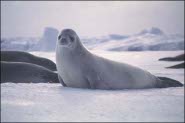
Crabeater seal


StumbleUpon Toolbar Stumble this page!

Animal of the Day
Subscribe to the
animal of the day
Enter your Email


Powered by FeedBlitz

Top articles


Animals living in the water
Swim with manatees - harmful or helpful?

Pictures of the crabeater seal are copyrighted
by their owners

Crabeater seal

Order : Carnivora
Family : Phocidae
Species : Lobodon carcinophagus


Crab eater sealThe Crabeater Seal (Lobodon carcinophagus) lives in the pack ice around Antarctica. It weighs about 20 kgs upon birth, and is around 1.5 to 1.6 meters long. Male adults range from 203 cm to 241 cm and have a weight of up to 225kgs. They have a long, pronounced snout, which, when agitated, has foam at their mouth. The majority of Crabeater Seals are scarred, and these parallel scars traverse the sides and the back.

There have been sightings of hundreds of seals congregating on a singular ice floe, but it could not be determined whether this multitude is in fact a social manifestation or it just happened by chance. They are first and foremost pack-ice creatures, but a Crabeater Seal can sometimes be found at the shore's territories.

The newborns come out mainly in September and October, and it is very common during these periods for them to be in trios. The male, female and the young. Male Crabeater Seals would be aggressive if a leopard seal thinks it could encroach on its territory. It is known that it could be threatening humans as well.

Their diet has been estimated to consist of 45 percent krill, 35 percent seals, 10 percent penguins, and 10 percent fish and cephalopods. One captured individual was observed closely, and it was discovered that it could suck preys to its mouth in a single gulp from lengths of up to 50 centimeters. This food was kept inside its mouth by the seal pressing its tongue to the palate, at the same time, it would bring up its lips to release the water.

It may not have a lot of predators it has to escape from, but it sure has a lot of competitors for krill. These are whales, other seals and even humans.

Interesting fact: Facial scars and at the flippers come from wounds acquired during their breeding days.

The Crabeater seal is listed as Least Concern (LR/lc), lowest risk. Does not qualify for a more at risk category. Widespread and abundant taxa are included in this category, on the IUCN Red List of Threatened Species
Namings for the crabeater seal
A young / baby of a crabeater seal is called a 'pup'. The females are called 'cow' and males 'bull'. A crabeater seal group is called a 'pod, colony, crash, flock, harem, bob, herd, rookery, team or hurd'.
Countries
Antarctica

Facts about the crabeater seal

carcinophagus) The Crabeater seal is the most common seal in the world, and may even be the most numerous mammal

Crabeater seals The Crabeater seal is one of the other prey species of the Leopard seal.

The Antarctican is reporting that "A belief that the most abundant large wild mammal in the world is Antarctica's crabeater seal is being radically revised down as results of a multi-nation survey are analysed.

The crabeater seal is one of the most remarkable, though least known, of the mammals of the

The crabeater seal is the most abundant of the pack-ice seals, and is thought to be the largest single consumer of krill.

The crabeater seal is the most abundant seal in the world, with a population between fifteen and forty million (more than all other seals put together) [1].

Geographic Range The crabeater seal, Lobodon carcinophagus, is primarily found on the coast and pack ice of Antarctica. (Full text)

The crabeater seal is long and slender with an elongated, upturned snout. (Full text)

Crabeater seals are known to move great distances inland! (Full text)

How many crabeater seals are there? (Full text)

The Crabeater Seal, Lobodon carcinophagus, is one of the most remarkable, though least known, of the mammals of the world. (Full text)

Crabeater Seals are the most common seals. (Full text)

Crabeater seals are now (Full text)

Crabeater seals are an abundant pack-ice predator which feed almost exclusively on krill. (Full text)

Crabeater seals are uniquely adapted amongst seals in that their teeth are adapted to form a sieve in a similar manner to the baleen plates of the great whales. (Full text)

Crabeater seals are Antarctic true (Full text)

The Crabeater seal is the most abundant of the pack-ice seals, and is now the largest single consumer of krill. (Full text)

Distribution and Habitat The crabeater seal is circumpolar in distribution, following the (Full text)

Distribution and Numbers Crabeater seals are the most numerous pinniped species in (Full text)

Many crabeater seals are scarred from leopard seals and to a lesser extent, killer whale attacks. (Full text)

Breeding in the Crabeater Seal is such that many scientists contend that their population will exceed 50,000,000 animals by the end of the century. (Full text)

1. crabeater seal, crab-eating seal -- (silvery gray Antarctic seal subsisting on crustaceans)
crabeater seal
crab-eating seal
(Source WordNet)

Google
Contact Us | ©2008 TheWebsiteOfEverything.com | Pictures and facts about the Crabeater seal