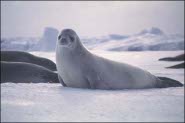
 The Crabeater Seal (Lobodon carcinophagus) lives in the pack ice around Antarctica. It weighs about 20 kgs upon birth, and is around 1.5 to 1.6 meters long. Male adults range from 203 cm to 241 cm and have a weight of up to 225kgs. They have a long, pronounced snout, which, when agitated, has foam at their mouth. The majority of Crabeater Seals are scarred, and these parallel scars traverse the sides and the back.
There have been sightings of hundreds of seals congregating on a singular ice floe, but it could not be determined whether this multitude is in fact a social manifestation or it just happened by chance. They are first and foremost pack-ice creatures, but a Crabeater Seal can sometimes be found at the shore's territories.
The newborns come out mainly in September and October, and it is very common during these periods for them to be in trios. The male, female and the young. Male Crabeater Seals would be aggressive if a leopard seal thinks it could encroach on its territory. It is known that it could be threatening humans as well.
Their diet has been estimated to consist of 45 percent krill, 35 percent seals, 10 percent penguins, and 10 percent fish and cephalopods.
It may not have a lot of predators it has to escape from, but it sure has a lot of competitors for krill. These are whales, other seals and even humans.
Interesting fact: Facial scars and at the flippers come from wounds acquired during their breeding days.
The Crabeater seal is listed as Least Concern (LR/lc), lowest risk. Does not qualify for a more at risk category. Widespread and abundant taxa are included in this category, on the IUCN Red List of Threatened Species
Namings for the crabeater seal
A young / baby of a crabeater seal is called a 'pup'. The females are called 'cow' and males 'bull'. A crabeater seal group is called a 'pod, colony, crash, flock, harem, bob, herd, rookery, team or hurd'.Countries
Antarctica
Custom Search