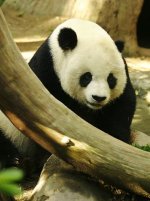
Giant panda


StumbleUpon Toolbar Stumble this page!

Animal of the Day
Subscribe to the
animal of the day
Enter your Email


Powered by FeedBlitz

Top articles


Animals living in the water
Swim with manatees - harmful or helpful?

Ailuropoda melanoleuca posters
Some facts about the
Giant panda

Adult weight : 117.5 kg (258.5 lbs)

Maximum longevity : 37 years

Female maturity :2192 days

Male maturity : 2192 days

Gestation : 48 days

Weaning : 182 days

Litter size : 2

Litters per year : 1

Interval between litters : 548 days

Weight at birth : 0.11 kg (0.242 lbs)

Weight at weaning : 22 kg (48.4 lbs)

Source: AnAge, licensed under CC

Giant panda

Order : Carnivora
Family : Ursidae
Subfamily : Ailurinae
Species : Ailuropoda melanoleuca


Giant PandaThe giant panda bear (Ailuropoda melanoleuca) is classified as a member of the family Ursidae (bears) and is native in Southern and Central China. Its diet consists almost completely on bamboo, although eggs, insects and fish act as necessary supplement of protein. Although it is a bear, it does not hybernate, just like other subtropical mammals. Because of habitat loss and low birthrate, the Giant Panda is an endangered species. They spend, on average, 12 hours a day eating bamboo. The problem with bamboo is that when the plants reach maturity, they give seeds and die all at once, forcing the panda to move to another area. When areas are disturbed by humans or cut off, the Giant Panda is in danger. Only about 1600 live in the wild, and estimates around 300 are living in zoos around the world. Until 1997, killing a Giant panda in China resulted in the death penalty (in 1997, the sentence was changed to 20 years of prison). Pandas can become 34 years of age in captivity. In the wild they usually become 14 to 20 years of age.

Photo by Aaron Logan, licensed under Creative Commons Attribution 1.0.

The Giant panda is listed as Endangered (EN), considered to be facing a very high risk of extinction in the wild, on the IUCN Red List of Threatened Species
Namings for the giant panda
A young / baby of a giant panda is called a 'cub'. The females are called 'sow' and males 'boar'.
Countries
China

Facts about the giant panda

Ailuropoda melanoleuca is the name scientists gave the giant panda, probably the most loved and most endangered of bears.

Description: The giant panda is a small black and white

giant panda is beloved by people from all over the world.

Habitat: Giant pandas are found in mixed deciduous/evergreen montane temperate forest, with a bamboo/rhododendron understory,

Just wanted to let you know that Ailuropoda melanoleuca is the scientific name of the Giant panda, not the walrus (the name means means black-and-white panda hand).

The giant panda (Ailuropoda melanoleuca) is an herbivore, existing on a diet of bamboo (Schaller et al.

The giant panda is a large mammal weighing between 165-353 pounds.

The giant panda, Ailuropoda melanoleuca, is a bearlike animal that has dense white fur with black markings on

The Panda Bear (Ailuropoda melanoleuca) is a probably the most famous endangered animal in the world.

When compared with other bears, the head of the giant panda is large in relation to its body.

8885 How the Giant Panda (Ailuropoda melanoleuca) is related to bears (Full text)

Giant pandas are black and white bears that live in temperate-zone bamboo forests in central China. (Full text)

Countries Where the Giant Panda Is Currently Found: 2004: Occurs in China (Gansu, Shaanxi, (Full text)

The Giant Panda, Ailuropoda melanoleuca, is a rare and endangered mammal from central China. (Full text)

Giant pandas are black and white and usually weigh 300-600 lbs. (Full text)

Please Note: The giant panda (Ailuropoda melanoleuca) is generally classified as a bear The lesser panda (not pictured) also called the red, or common, panda (Ailurus fulgens) is placed in the raccoon family. (Full text)

Giant pandas are members of the bear family, and they are mammals. (Full text)

comAll About PandasThe Giant PandaAiluropoda melanoleuca PandaInformation Coloring Printout LabeledColoring Printout Unlabeled Quiz to Print Word Search Puzzle Panda Linkson the Web Pandas Giant pandas are black-and-white Chinese bears that are on the verge of extinction. (Full text)

Finally, scientists concluded the giant panda (Ailuropoda melanoleuca) is indeed a bear, but is different enough in its anatomy and behavior to belong to a subfamily of its own. (Full text)

The remaining 10 hours the giant panda is spent resting, in periods of about two hours. (Full text)

The Giant Panda, Ailuropoda melanoleuca, is called da4xiong2mao1 (big-bear-cat) or da4mao1xiong2 (big-cat-bear) in Chinese, and the Red Panda, Ailurus fulgens, is called xiao3xiong2mao1 (small-bear-cat) or xiao3mao1xiong2 (small-cat-bear). (Full text)

Scientists disagree about whether the giant panda is closely related to bears or raccoons or is separate from both. (Full text)

Giant pandas are an endangered species (Full text)

Giant pandas are classified as bears and have the digestive system of a carnivore, but they have adapted to a vegetarian diet and depend almost exclusively on bamboo as a food source. (Full text)

The giant panda is universally loved, and of course has a special significance for WWF as it has been the organization's symbol since it was formed in 1961. (Full text)

The giant pandas are known to eat 26 different plant species, but 99% of the giant pandas diet is made up of bamboo. (Full text)

• Giant pandas are technically carnivores, but they have adapted to live mostly on bamboo. (Full text)

Giant Pandas Are Black and White and Loved All Over The giant panda is a national treasure in China and is therefore (Full text)

The basic fur color of the giant panda is white with black eye patches, ears, legs, feet, chest, and shoulders. (Full text)

1. giant panda, panda, panda bear, coon bear, Ailuropoda melanoleuca -- (large black-and-white herbivorous mammal of bamboo forests of China and Tibet; in some classifications considered a member of the bear family or of a separate family Ailuropodidae)
giant panda
panda
panda bear
coon bear
Ailuropoda melanoleuca
(Source WordNet)

Google
Contact Us | ©2008 TheWebsiteOfEverything.com | Pictures and facts about the Giant panda