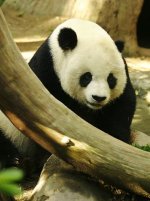
 The giant panda bear (Ailuropoda melanoleuca) is classified as a member of the family Ursidae (bears) and is native in Southern and Central China. Its diet consists almost completely on bamboo, although eggs, insects and fish act as necessary supplement of protein. Although it is a bear, it does not hybernate, just like other subtropical mammals. Because of habitat loss and low birthrate, the Giant Panda is an endangered species. They spend, on average, 12 hours a day eating bamboo. The problem with bamboo is that when the plants reach maturity, they give seeds and die all at once, forcing the panda to move to another area. When areas are disturbed by humans or cut off, the Giant Panda is in danger. Only about 1600 live in the wild, and estimates around 300 are living in zoos around the world. Until 1997, killing a Giant panda in China resulted in the death penalty (in 1997, the sentence was changed to 20 years of prison). Pandas can become 34 years of age in captivity. In the wild they usually become 14 to 20 years of age.
 Photo by Aaron Logan, licensed under Creative Commons Attribution 1.0.
Keywords: black , white , orange
Which zoos have them?
Smithsonian National Zoological Park (United States)The Giant panda is listed as Endangered (EN), considered to be facing a very high risk of extinction in the wild, on the IUCN Red List of Threatened Species
Namings for the giant panda
A young / baby of a giant panda is called a 'cub'. The females are called 'sow' and males 'boar'.Countries
ChinaSome facts about the
Giant panda
Adult weight : 117.5 kg (258.5 lbs)
Maximum longevity : 37 years
Female maturity :2192 days
Male maturity : 2192 days
Gestation : 48 days
Weaning : 182 days
Litter size : 2
Litters per year : 1
Interval between litters : 548 days
Weight at birth : 0.11 kg (0.242 lbs)
Weight at weaning : 22 kg (48.4 lbs)

Custom Search