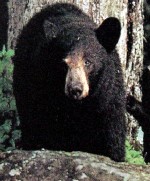
 The Asiatic black bear (Ursus thibetanus) (or Moon bear, Tibetan black bear or the Himalayan black bear) can be found in moist forests and brushland in countries ranging from Russia, Korea, Taiwan, Afghanistan, India, China and Japan. It is omnivorous and its diet consists of fruits, berries, etc., honey and meat (fish, birds, and small mammals). It is a little bit more carnivorous than its American cousin, the American black bear, and it is less strong than the brown bear. It is threatened by deforestation and habitat loss. Until the 1980's the Asiatic black bears were also hunted in the wild for their gall bladders which are used in Chinese medicine. Since China outlawed the poaching of the bears, the gall bladders are supplied by special farms in China which provide bile by caging and restraining the bears while catheters are inserted in their gall bladders allow bile to drip into a container. Recently, European parlement passed a resolution to put pressure on China to ban these farms, because of the inhumane and cruel handling of these animals. It can be argued that without these farms the supply for bear bile would not meet demand, causing more illegal poaching of the already endangered bears. Synthetic bile may be the solution?
Keywords: black , white , brown
The Asiatic black bear, himalayan black bear is listed as Vulnerable (VU), considered to be facing a high risk of extinction in the wild, on the IUCN Red List of Threatened Species
Namings for the Asiatic black bear
A young / baby of a Asiatic black bear is called a 'cub'. The females are called 'sow' and males 'boar'. A Asiatic black bear group is called a 'sleuth or sloth'.Countries
Afghanistan, Bhutan, Burma, Cambodia, China, India, Iran, Japan, Korea, North, Korea, South, Laos, Mongolia, Nepal, Pakistan, Russia, Taiwan, Thailand and VietnamSome facts about the
Asiatic black bear
Adult weight : 103.75 kg (228.25 lbs)
Maximum longevity : 39 years
Female maturity :1095 days
Male maturity : 1095 days
Gestation : 228 days
Weaning : 99 days
Litter size : 2
Interval between litters : 365 days
Weight at birth : 0.463 kg (1.0186 lbs)

Custom Search