
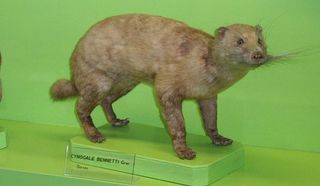
Author: Mariomassone
Permission: GNU Free Documentation License
Otter civet
Order : Carnivora
Family : Viverridae
Subfamily : Hemigalinae
Species : Cynogale bennettii
Keywords: claw , whisker , nocturnal
The Otter civet, otter-civet is listed as Endangered (EN), considered to be facing a very high risk of extinction in the wild, on the IUCN Red List of Threatened Species
Otter civet habitats
Bogs, Marshes, Swamps, Fens, Peatlands, Permanent Rivers / Streams / Creeks (includes waterfalls) and Wetlands (inland)
Facts about the otter civet
The otter civet is found in Peninsular , southern , Sumatra and Borneo, and possibly . (Full text)
The Otter Civet is nocturnal species that obtains its food from the water, feeding on fish, crabs, freshwater mollusks, as well as being able to climb to feed on birds and fruit. (Wiki)
The Otter Civet, Cynogale bennettii, is an aquatic civet from South East Asia. (Wiki)
Habitat: The otter civet is found in and near streams, rivers and wetlands. (Full text)
The otter civet is found in Peninsular Malaysia, southern Thailand, Sumatra and Borneo, and (Full text)
Lowe’s otter civet is one of only two species of otter civets, which are so named for their resemblance to otters in habit and appearance. (Full text)
Otter civets are good swimmers, but they can also climb trees. (Full text)
More animals beginning with O