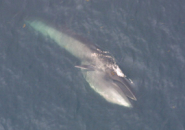
 The Sei Whale (Balaenoptera borealis) is a large baleen whale that lives in all the oceans of the world. It is a dark steel gray color and has white spots on its underside. The Sei Whale is a very large animal and is generally lengthy and slender in shape. They can measure up to 20 meters long (66 feet) but usually are around 12-15 meters long. They weigh over 50 tons (45 tonnes) in some cases with the average being around 40 tons, and are very powerful swimmers. The have short pectoral fins, and their sickle shaped dorsal fin can be from 25-61 centimeters in height. The mouth of the Sei Whale is enormous, and has over 300 baleen plates (300-380 in most cases) which are a dark ash-black color, while the bristles are white. A baby whale, called a calf, will weigh several tons when born, and will grow quickly. By the age of 6-8 it will be mature enough to mate, and by this time is an independent member of the group.
 The longevity of the Sei Whale is not fully known, however individuals have been found that are sixty years old, while the average age found is between that and a calf. However there is circumstantial evidence that they may live well past sixty, provided that they are no longer hunted as they used to be.
Sei Whales belong to the genus Balaenoptera, which has seven other species of whale, including the Blue Whale and the Fin Whale, Baleaenoptera belongs to the family Balaenopteridae, which has only one other family living called Megapterinae, with only one species in that (the Humpback Whale). All other species that belonged to this family are though to be extinct today. The family Balaenopteridae belongs to the suborder Mysticeti, which includes all other baleen whales. Finally, Mysticeti belongs to the order Cetacea that includes many extinct species, and many living species such as the Dolphin, the Killer Whale, and the Sperm Whale.
Migration patterns of the Sei Whale fallow an irregular set of going between the cooler areas in summer, and the warmer in winter - as they follow the weather than a set routine. Usually in the Northern Hemisphere this means that during the summer they will go from around the state of Georgia to the country of Greenland, but avoid any partially enclosed areas of water - preferring to stay where it is deep. They do this to follow the food that they eat, which also is of more abundance in cooler areas in summer, and warmer areas in winter. In the southern hemisphere they will migrate south toward Antarctica during the summer and north to Africa and South America in winter - which happens at opposite times from our own weather patterns. Some may cross the equator and travel all the way north, and vice versa.
Interesting Facts about Sei Whales:
- A Sei Whale can swim past 50 kilometers per hour (31 miles per hour)
- Sei Whales make long vocalizations and whale songs, mainly of low rumblings, however are also known to make short higher pitched noises, and even some that seem like growls.
Keywords: white , blue , migrate
The Coalfish whale, pollack whale, rudophi's rorqual, sei whale is listed as Endangered (EN), considered to be facing a very high risk of extinction in the wild, on the IUCN Red List of Threatened Species
Namings for the sei whale
A young / baby of a sei whale is called a 'calf'. The females are called 'cow' and males 'bull'. A sei whale group is called a 'gam, pod or herd'.Countries
Argentina, Australia, Canada, Chile, Falkland Islands (Islas Malvinas), Iceland, India, Indonesia, Japan, Kenya, Korea, North, Korea, South, Malaysia, Mexico, Mozambique, Norway, Poland, Reunion, Russia, South Africa, Spain, Suriname, Taiwan, Tanzania, Thailand, United Kingdom, United States and UruguaySome facts about the
Sei whale
Adult weight : 20000 kg (44000 lbs)
Maximum longevity : 74 years
Female maturity :3652 days
Male maturity : 3652 days
Gestation : 345 days
Weaning : 266 days
Litter size : 1
Litters per year : 1
Interval between litters : 730 days
Weight at birth : 680 kg (1496 lbs)

Custom Search