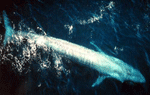
 The blue whale (Balaenoptera musculus) was hunted almost to extinction until hunting was outlawed in 1966, and today humans still disturb these beautiful underwater giants. With the increase of the noise from ships and military sonar, blue whales have a hard time communicating with each other. Read about it on National Geographic. Furthermore, they are threatened by illegal whaling, pollution and fishing nets. The world population is estimated between 3,000 and 4,000 (source). They are considered an endangered species. Yesterday i saw an episode of Genographic Project on National Geographic, about the evolution on whales. According to the Genographic project, all cetaceans descended from a wolf-like creature. But a little search on google shows a lot of different views, including the hippopotamus. Did you know adult blue whales are about the same size as a boeing 737 ?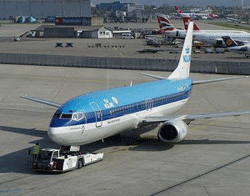
Keywords: blue
The Blue whale, sibbald's rorqual, sulphur-bottom whale is listed as Endangered (EN), considered to be facing a very high risk of extinction in the wild, on the IUCN Red List of Threatened Species
Namings for the blue whale
A young / baby of a blue whale is called a 'calf'. The females are called 'cow' and males 'bull'. A blue whale group is called a 'gam, pod or herd'.Countries
Argentina, Australia, Burma, Canada, Cape Verde, Chile, Ecuador, Falkland Islands (Islas Malvinas), French Polynesia, French Southern and Antarctic Lands, Greenland, Iceland, India, Indonesia, Japan, Kenya, Korea, North, Korea, South, Malaysia, Mexico, Namibia, New Zealand, Nicaragua, Norway, Pakistan, Panama, Peru, Russia, South Africa, Spain, Sri Lanka, Svalbard, Taiwan, Tanzania, United Kingdom, United States and UruguaySome facts about the
Blue whale
Adult weight : 136000 kg (299200 lbs)
Maximum longevity : 110 years
Female maturity :1827 days
Male maturity : 1827 days
Gestation : 350 days
Weaning : 182 days
Litter size : 1
Interval between litters : 914 days
Weight at birth : 2000 kg (4400 lbs)
Weight at weaning : 17000 kg (37400 lbs)
