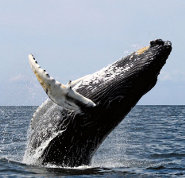
 Humpback whales (Megaptera novaeangliae) are a once-endangered species of whale that was salvaged from the very brink of annihilation due to a moratorium on whaling in 1966. Before this their numbers had dwindled to an alarmingly low number – however today there are nearly 90,000 of them; although not as many as there once were, it is enough to insure the recovery and survival of these massive mammals. An adult Humpback Whale is usually between 45-50 feet in length (13-16 meters) and can weigh up to nearly 80,000 lbs – usually around 79-80 (36,000 kilograms). They have very large pectoral fins along with a narrow head, and are baleen whales (their teeth are like massive combs). Males of the species sing – or communicate – through sound transmitted across vast distances; these songs will usually last up to twenty minutes and it might have a role in mating.
 Humpback whales travel thousands of miles every year in their migrations, and are found in all oceans on the planet. They feed during the warm summer up or down toward the poles, then they travel to the tropical waters in winter to give birth to their young. When they’re in the tropical waters they live off of their vast fat stores for energy, and migrate back to the polar waters to replenish the supply through feeding.
The Binomial Name for the Humpback Whale is Megaptera novaeagliae, as it belongs to the Megaptera genus, of which it is the only living member. Megaptera in turn belongs to the Family Balaenopteridae, which are all of the rorquals whales, of which there are two genera and nine species – eight of which are in the Balaenoptera genus which has all other rorqual baleen whales such as the Blue Whale, Fin Whale, Sei Whale and more. Balaenopteridae belongs to the Suborder Mysticeti of which all baleen whales belong to – living and extinct, and includes the Bowhead Whale, Southern and Northern Right Whales, Gray Whale, and Pygmy Right Whale. Mysticeti belongs to the Order Cetacea of which all whales, dolphins, and porpoises belong. A suggested Infraorder is Whippomorpha which would class the Hippopotamus with Cetacea and thus bring them into the fold. However, the next currently recognized step from Cetacea is the Superorder Laurasiatheria, of which bats, moles, hedgehogs, even and odd toed ungulates, anteaters, and carnivores are members. Laurasiatheria belongs to the Infraclass Eutheria of which all the Placentals are a member, and this belongs to the Subclass Theria of which all mammals that give birth to live young belong, and this belongs to the Class of Mammalia, which includes all the mammals.
Facts about the Humpback
- Humpback Whales are thought to live up to 60 years – however new evidence suggest that they may live to be well over 200 years old.
- Humpback whales are very athletic for their size, they will breach into the air – lifting most of their body weight out of the water and then splashing back down in a display of power for a possible mate. Additionally they spy-hop (where their heads come out of the water and they ‘spy’), lobtail (where their flukes come out of the water and then slap down hard), and slapping their flippers.
Picture of the humpback whale by Wwelles14, licensed under GFDL
The Bunch, hump whale, humpback whale, hunchbacked whale is listed as Vulnerable (VU), considered to be facing a high risk of extinction in the wild, on the IUCN Red List of Threatened Species
Namings for the humpback whale
A young / baby of a humpback whale is called a 'calf'. The females are called 'cow' and males 'bull'. A humpback whale group is called a 'gam, pod or herd'.Countries
American Samoa, Angola, Argentina, Australia, Benin, Bermuda, Brazil, Canada, Cape Verde, Chile, Congo, Democratic Republic of the, Congo, Republic of the, Cook Islands, Dominican Republic, Ecuador, Falkland Islands (Islas Malvinas), Fiji, France, Greenland, Iceland, India, Indonesia, Iraq, Japan, Kenya, Korea, North, Korea, South, Madagascar, Malaysia, Marshall Islands, Mexico, Mozambique, Netherlands Antilles, New Caledonia, New Zealand, Northern Mariana Islands, Norway, Pakistan, Panama, Peru, Poland, Russia, Saint Lucia, Saint Vincent and the Grenadines, Samoa, Solomon Islands, South Africa, Sri Lanka, Svalbard, Tanzania, Tonga, United Kingdom, United States, Vanuatu and VenezuelaSome facts about the
Humpback whale
Adult weight : 30000 kg (66000 lbs)
Maximum longevity : 95 years
Female maturity :1643 days
Male maturity : 1643 days
Gestation : 342 days
Weaning : 236 days
Litter size : 1
Litters per year : 1
Interval between litters : 657 days
Weight at birth : 1350 kg (2970 lbs)

Custom Search