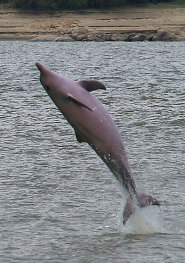
 The tucuxi (Sotalia fluviatilis) is also called the bufeo negro, the grey dolphin or the marine tucuxi dolphin. "Tucuxi" is pronounced "too koo she." It is unknown how many of these rare dolphins are left. It is also unknown what natural predators feed on them except people. Many dolphins die due to water pollution and from getting caught in fisherman’s nets. Since dolphins need to breathe air, they soon drown in the nets. River dolphins can become stranded when rivers hit their lowest during the dry season.
There are two subspecies of the tucuxi and it is unknown whether they can interbreed. The riverine subspecies, Sotalia fluviatilis fluviatilis lives in freshwater rivers cutting through the tropical rain forest. The marine subspecies, Sotalia fluviatilis guianensis, lives in the coastal ocean waters off of Brazil, Ecuador, Columbia and Peru.
Physical Description
Both subspecies of tucuxi look like, except the marine subspecies is slightly larger than the freshwater. Adult marine tucuxi grow up to 86.61 inches long (220 centimeters) while freshwater tucuxi grow to a length of only 59 inches (150 centimeters.) Adults of the marine subspecies weigh an average of 99.2 pounds (45 kilograms) while the freshwater subspecies weighs only 77.16 pounds (35 kilograms.)
Both subspecies strongly resemble a small
Life Cycle and Behavior
Tucuxi prefer to live in small pods or family groups from 15 to 50. The salt-water subspecies tend to live in larger pods. Males do fight for females, which then mate with more than one male if presented with the opportunity. Both subspecies eat fish and shellfish. Since the water is dark and hard to see through, they rely on echolocation in order to find prey and to navigate. Females of both subspecies have a gestation of 11 to 12 months and give birth to a single calf, often in November.
Tucuxi are most active at dawn and at dusk. They are less playful than other dolphin species, but sometimes leap out of the water. With luck, a tucuxi can live to be 35 years old. They do not do well in captivity.
Picture of the tucuxi by Archilider, licensed under the Creative Commons Attribution-Share Alike 3.0 Unported and GFDL.
Keywords: pink
The Estuarine dolphin, gray dolphin, guianian river dolphin, tucuxi is listed as Data Deficient (DD), inadequate information to make a direct, or indirect, assessment of its risk of extinction, on the IUCN Red List of Threatened Species
Namings for the gray dolphin
A young / baby of a gray dolphin is called a 'calf or pup'. The females are called 'cow' and males 'bull'. A gray dolphin group is called a 'team, school, pod, herd, alliance (male) or party (female)'.Countries
Bolivia, Brazil, Colombia, Ecuador, French Guiana, Guyana, Honduras, Nicaragua, Panama, Peru, Suriname, Trinidad and Tobago and VenezuelaGray dolphin habitats
Estuaries, Marine Neritic, Pelagic, Permanent Freshwater Lakes (over 8ha), Permanent Rivers / Streams / Creeks (includes waterfalls) and Wetlands (inland)Some facts about the
River dolphin
Adult weight : 46.667 kg (102.6674 lbs)
Gestation : 325 days
Litter size : 1
