
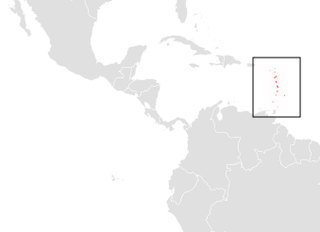
Original source: Base map derived from File:BlankMap-World.png. Distribution data from IUCN Red List1
Author: Felineora
Tree bat
Order : Chiroptera
Family : Phyllostomidae
Subfamily : Stenodermatinae
Species : Ardops nichollsi
The Tree bat is listed as Near Threatened (LR/nt), is close to qualifying for or is likely to qualify for a threatened category in the near future, on the IUCN Red List of Threatened Species
Namings for the tree bat
A young / baby of a tree bat is called a 'pup'. A tree bat group is called a 'colony or cloud'.Countries
Guadeloupe, Martinique, Montserrat, Netherlands Antilles, Saint Lucia and Saint Vincent and the Grenadines
Facts about the tree bat
Tree bats are more solitary than cave bats.
Each year, tree bats are encountered at latitudes above 38° in North America during the summer but are mostly absent during the winter.
IDENTIFICATION: Tree bats are medium-sized bats with a wingspan just over 30 cm.
nicholisi montserratensis, the Tree Bat is a small fruit eater (Peterson et al.
South Dakota’s tree bats are the hoary bat, the eastern red bat, and the silver-haired bat.
Tree bats are more solitary than cave bats in both hibernation and raising young.
Unwary humans and benign moonbats step under their perch at great peril, as the the Tree-bat is known to toss feces, firebombs, or just leap downwards and pounce on its prey.
Tree bats are solitary, unlike the social nature of cave bats. (Full text)
More animals beginning with T