
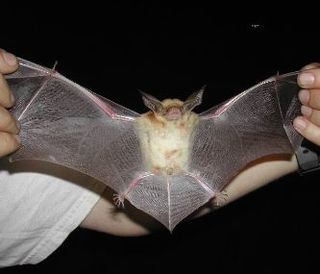
Pallid bat
Order : Chiroptera
Family : Vespertilionidae
Subfamily : Vespertilioninae
Species : Antrozous pallidus
The Pallid bat is listed as Least Concern (LR/lc), lowest risk. Does not qualify for a more at risk category. Widespread and abundant taxa are included in this category, on the IUCN Red List of Threatened Species
Namings for the pallid bat
A young / baby of a pallid bat is called a 'pup'. A pallid bat group is called a 'colony or cloud'.Some facts about the
Pallid bat
Adult weight : 0.021 kg (0.0462 lbs)
Maximum longevity : 15 years
Female maturity :365 days
Male maturity : 365 days
Gestation : 62 days
Weaning : 50 days
Litter size : 2
Weight at birth : 0.003 kg (0.0066 lbs)
Body mass : 0.022 kg (0.0484 lbs)
Temperature : 33.85 °C (92.93 °F)
Facts about the pallid bat
The pallid bat, Antrozous pallidus, is a large pale bat that occurs in part of the western United States, as well as in much of Mexico, Cuba, and a small area of southwestern Canada. (Full text)
First of all, Antrozous pallidus is a microbat which belongs to the Family Vespertilionidae, the second largest phylogenetic family of mammals (Altringham 1996).
Identification: Antrozous pallidus is a large (forearm 48‑60 mm), (Full text)
The pallid bat (Antrozous pallidus) is known for its unique habit of feeding almost entirely from the ground.
FDC: 37¢ Pallid Bat PSA First Day of Issue: September 13, 2002 Further Information about this issue: The pallid bat (species Antrozous pallidus) is distinguished by its long, pale ears.
Mark Kiser The pallid bat (Antrozous pallidus) is recognized by its more than one inch-long ears and light yellowish fur.
The Pallid Bat (Antrozous pallidus) is fairly large, light-colored, and big-eared, found to the northwest as far as British Columbia. (Full text)
The pallid bat (Murciélago pálido or Antrozous pallidus) is a common desert species. (Full text)
The pallid bat is a large (total length, 92-135 mm; forearm length, 45-60 mm), pale, long-eared bat not easily confused with any other North American spec ies.
The pallid bat is known for its unique habit of feeding almost entirely from the ground. (Full text)
Official status The Pallid Bat is one of the rarest mammals in British Columbia and is
The Pallid Bat is known only from Barber County where it hibernates in the caves and rock crevices during winter.
Posted on Sunday, July 14, 2002 @ 01:20:56 PSTPallid bat - Antrozous pallidus The pallid bat is known for its unique habit of feeding almost entirely from the ground.
The pallid bat differs from most North American bats in that it hunts primarily ground-dwelling and slow-flying prey, feasting on moths, cicadas, crickets, scorpions and even small mice and lizards (the pallid bat is immune to scorpion venom).
Pallid Bat ClassOrderFamilySpecies Mammalia Chiroptera Vespertilionidae Antrozous pallidus Pallid Bat Distribution, Abundance, and Seasonality DISTRIBUTION, ABUNDANCE, AND SEASONALlTY The pallid bat is a locally common species of low elevations in California. (Full text)
Pallid Bat Antrozous pallidusHabitat: The pallid bat is found mostly in semidesert and montane shrublands, piñon-juniper woodlands, and riparian woodland in the foothills and canyon country. (Full text)
The pallid bat is large and pale, with large ears (not joined at base), large eyes, a simple muzzle, and a yellowish drab dorsal pelage that is paler towards the hair tips and darker at the base (palest in deserts, darkest along coast).
Habitat The pallid bat is usually found in rocky, montainous areas and near water. (Full text)
Meet Our Bats The Pallid Bat Antrozous pallidus Back to Meet Some Bats Pallid bats are fairly common at lower elevations throughout the Southwest.
The extent to which pallid bats are able to use bat houses, however, is not well understood.
Pallid Bats are a pale buff-colored medium-sized bat.
Pallid bats are very sensitive to disturbance. (Full text)
Pallid Bats are found in Cimarron, Woodward and Woods counties and in the Wichita Mountains.
To some extent though, pallid bats are terrestrial foragers. (Full text)
Life History: Pallid bats are gregarious, (Full text)
More animals beginning with P