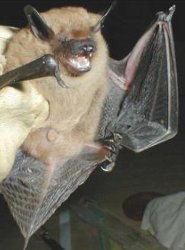
 Big brown bats (Eptesicus fuscus) - While many mammals are capable of gliding, bats are the only mammals capable of true powered flight (excluding humans with their ingenious mechanical aids). The only other groups of animal to achieve this are insects, pterosaurs (now extinct) and birds. Remarkable, all four groups evolved this amazing ability independently.
The ability to fly is perhaps even more impressive in the case of the big brown bat because they are, as the name suggests, bigger than most bat species. Big brown bats typical weigh in at about 18 grams (5/8 ounce) and are about 12.5 centimetres (5 inches) in length.
Big brown bats are nocturnal, that is to say they are mostly active during the night. This presents them with a problem; with no light to see by how do they navigate in the dark? Those nocturnal animals with their feet firmly on the ground frequently solve this problem with an improved sense of touch, hearing and/or smell. However, many species of bat, including big brown bats, have evolved an alternative solution: echolocation. This mechanism is very similar to sonar used by humans but, as with flight, bats got there first. The bats release ultrasound waves from their mouths or noses and then receive and analyse the echo, which will have bounced off the surfaces of surrounding objects, including prey items such as insects.
Detection of prey by echolocation, and of course the evasive manoeuvres of the unwilling prey, largely accounts for the frequent and rapid changes in direction observed during a big brown bat's flight.
During the day big brown bats will roost in trees, caves or old buildings. This provides them with some protection against the elements and against being eaten by predators while they sleep.
Big brown bats are known to hibernate during the winter months. Hibernation involves a period of reduced metabolism, which means the bats have a reduced energy requirement during the harsh winter months when little food is available. However, during hibernation they require a steady temperature and thus require somewhere with a relatively constant temperature. Typically this takes the form of an underground area, such as a mine or a cave. However, the details of where big brown bats spend the winter have yet to be fully elucidated, requiring further scientific research.
The big brown bat mating season start in November and may continue all the way to March. Females that have been successfully impregnated will subsequently leave the main colony and form separate maternal colonies.
Big brown bats are fairly common with a low risk, ‘least concern' conservation classification. There are, in fact, two subspecies of big brown bat; Eptesicus fuscus fuscus and Eptesicus fuscus pallidus. You can expect to find E. fuscus fuscus all over the eastern coast of the United States except Florida. While, E. fuscus pallidus is found in Utah.
The big brown bat mating season start in November and may continue all the way to March. Females that have been successfully impregnated will subsequently leave the main colony and form separate maternal colonies.
Big brown bats are fairly common with a low risk, ‘least concern’ conservation classification. There are, in fact, two subspecies of big brown bat; Eptesicus fuscus fuscus and Eptesicus fuscus pallidus. You can expect to find E. fuscus fuscus all over the eastern coast of the United States except Florida. While, E. fuscus pallidus is found in Utah.
Which zoos have them?
Minnesota Zoo (United States)The Big brown bat is listed as Least Concern (LR/lc), lowest risk. Does not qualify for a more at risk category. Widespread and abundant taxa are included in this category, on the IUCN Red List of Threatened Species
Namings for the big brown bat
A young / baby of a big brown bat is called a 'pup'. A big brown bat group is called a 'colony or cloud'.Countries
Barbados, Canada, Colombia, Costa Rica, El Salvador, Guatemala, Honduras, Mexico, Nicaragua, Panama, Paraguay, Peru, Suriname, United States and VenezuelaSome facts about the
Big brown bat
Adult weight : 0.023 kg (0.0506 lbs)
Maximum longevity : 19 years
Female maturity :547 days
Male maturity : 730 days
Gestation : 35 days
Litter size : 2
Interval between litters : 365 days
Weight at birth : 0.004 kg (0.0088 lbs)
Weight at weaning : 0.017 kg (0.0374 lbs)
Body mass : 0.013 kg (0.0286 lbs)
Temperature : 35.85 °C (96.53 °F)

Custom Search