
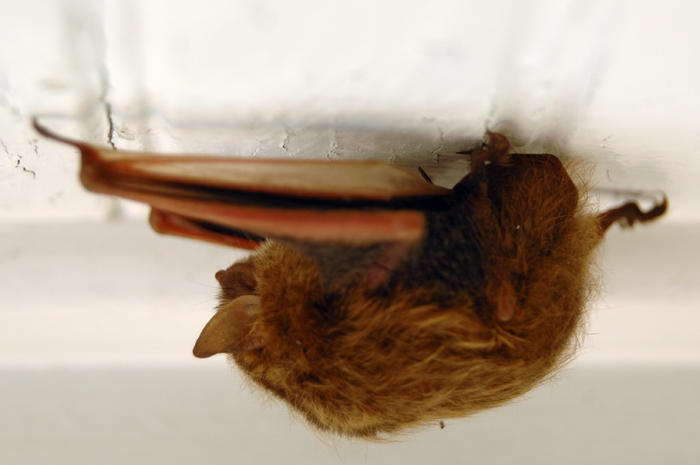
Eastern pipistrelle
Order : Chiroptera
Family : Vespertilionidae
Subfamily : Vespertilioninae
Species : Pipistrellus subflavus
The Eastern pipistrelle is listed as Least Concern (LR/lc), lowest risk. Does not qualify for a more at risk category. Widespread and abundant taxa are included in this category, on the IUCN Red List of Threatened Species
Some facts about the
Eastern pipistrelle
Adult weight : 0.008 kg (0.0176 lbs)
Maximum longevity : 15 years
Female maturity :212 days
Gestation : 44 days
Litter size : 2
Interval between litters : 365 days
Weight at birth : 0.001 kg (0.0022 lbs)
Weight at weaning : 0.005 kg (0.011 lbs)
Facts about the eastern pipistrelle
pipistrellus subflavus is mentioned in the following topics: Eastern Pipistrellepipistrellus (Full text)
These records suggest that Pipistrellus subflavus is of very rare but regular occurrence in southern costal New Brunswick.
Eastern Pipistrelle Eastern Pipistrelle Image here --> Scientific classification Kingdom:Animalia Phylum: Chordata Class: Mammalia Order:Chiroptera Family:Vespertilionidae Genus:Pipistrellus Species:subflavus Binomial name Pipistrellus subflavusCuvier 1832 The Eastern Pipistrelle (Pipistrellus subflavus) is a species of bats that is widely distributed throughout the eastern parts of North America, ranging west until Kansas and Texas, from eastern Mexico up north until southern Ontario.
Identification: Pipistrellus subflavus is a small yellowish-brown (Full text)
Cuvier, 1832 The Eastern Pipistrelle (Pipistrellus subflavus) is a species of bat that is widely distributed throughout the eastern parts of North America, ranging west until Kansas and Texas, from eastern Mexico up north until southern Ontario. (Wiki)
Pipistrellus subflavus is not considered a migratory species (Fujita and Kunz 1984, Griffin 1940): there are no reports of this species along expected migratory pathways (see Introduction), they only occur in low numbers in southern New Brunswick (Broders et al.
Pipistrelle Bat The pipistrelle bat (Pipistrellus subflavus ) is the smallest bat in Arkansas (total length up to 95 mm, or 3.
Caption: The Eastern pipistrelle (Pipistrellus subflavus) is particularly sensitive to freezing temperatures and is one of the first species to go into hibernation — often in caves —in the fall, and one of the last to emerge in spring.
The eastern pipistrelle (Pipistrellus subflavus) is one of the most common species of bats found throughout the eastern forests of America from Nova Scotia and Quebec, south throughout the east coast of Mexico into northern Central America.
The tiny eastern pipistrelle (Pipistrellus subflavus) is apparently incapable of lengthy migration and has its own unique strategies for surviving winter.
The eastern pipistrelle is one of the most common species of bats found throughout the eastern forests of America – from Nova Scotia and Quebec, south throughout the east coast of Mexico into northern Central America.
Eastern pipistrelle is one of the 15 species of bats found in Tennessee. (Full text)
The eastern pipistrelle is somewhat migratory, and many individuals wintering in Kentucky may go farther north for the summer. (Full text)
Description: The eastern pipistrelle is the smallest of the Adirondack bats. (Full text)
The Eastern pipistrelle is a dainty reddish yellow to light brown colored bat.
The eastern pipistrelle is one of the smallest of the park's bats and is fairly common. (Full text)
The eastern pipistrelle is also one of the slowest flyers among the bats, reaching a maximum speed of 6-9 kph.
The Eastern Pipistrelle is found throughout the state of Virginia in caves, trees/vegetation, sometimes buildings in both wooded and cleared areas. (Full text)
Eastern pipistrelles are also known to roost in Spanish moss.
Eastern pipistrelles are weak fliers and are so small that they may be mistake for a moth. (Full text)
Eastern Pipistrelles are the first to enter hibernation each fall and the last to leave the caves in the spring (Figure 1). (Full text)
Meanwhile, on the other side of the West Nueces River some 60 miles away, more than a million of their cousins, as well as a lesser number of cave myotis and eastern pipistrelles, are taking flight from the depths of Devil’s Sinkhole, a 310-foot collapsed limestone pit that is the heart of an 1,859-acre
Large variety found In the Cape Fear region, Clark says, hoary bats are the biggest species; Eastern pipistrelles are the smallest.
Meanwhile, on the other side of the West Nueces River some 60 miles away, more than a million of their cousins, as well as a lesser number of cave myotis and eastern pipistrelles, are taking flight from the depths of Devil’s Sinkhole, a 310-foot collapsed limestone pit that is the heart of an 1,859-acre state natural area. (Full text)
More animals beginning with E