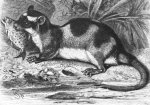
 The Water Opossum (Chironectes minimus) or Yapok can be found in many parts of the globe, just to mention some: South Mexico, Colombia, Guianas, Venezuale, parts of Brazil and Peru. The natural habitat of these animals range from subtropical up to tropical territories, and also near freshwater streams. It is not impossible to find Water Opossums at high-altitude areas. The hair covering of a Water Opossum is quite unusual, the fur is a combination of black and gray. Usually, the crown and the muzzle are predominantly black, with a pale band at the forehead. A Water Opossum's ears are round, and on top of the eyes are bristles. They are real water dwellers, their fur being water-repellent and not only that, they have webbed feet which makes it possible for them to swim quickly. These yapok's forefeet are not webbed, but have claws and long fingers. Male and females both have a a pouch, and for the females, they have a mechanism that seals the pouch, as this protects their young. The latter would be able to go on without oxygen for many minutes when they are underwater.
Life expectancy for these opossums is not known exactly, in captivity lifespan was recorded of up to 3 years. The Water Opossum is basically anti-social and a "loner". Usually, they reside in subterranean places but in the daytime, they utilize a ground nest composed of either leaves or grass.
They are not listed as endangered. However, they are indeed rare but whether this is due to its nocturnal way of living or their population is really small, even experts could only speculate.
Interesting fact They are the only kind of opossum that can move/survive in aquatic environments.
Keywords: pouch
The Water opossum, yapok is listed as Near Threatened (LR/nt), is close to qualifying for or is likely to qualify for a threatened category in the near future, on the IUCN Red List of Threatened Species
Countries
Argentina, Belize, Bolivia, Brazil, Colombia, Costa Rica, Ecuador, El Salvador, French Guiana, Guatemala, Guyana, Honduras, Mexico, Nicaragua, Panama, Paraguay, Peru, Suriname and VenezuelaWater opossum or yapok habitats
Forest, Permanent Freshwater Lakes (over 8ha), Permanent Rivers / Streams / Creeks (includes waterfalls), Subtropical / Tropical Dry forest, Subtropical / Tropical Moist Lowland and Wetlands (inland)Some facts about the
Water opossum (yapok)
Adult weight : 0.7 kg (1.54 lbs)
Maximum longevity : 3 years
Female maturity :304 days
Litter size : 4
Basal metabolic rate : 3 W
Body mass : 0.941 kg (2.0702 lbs)
Temperature : 34.85 °C (94.73 °F)

Custom Search