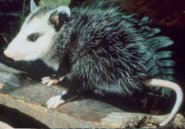
 The Southern Opossum (Didelphis marsupialis) (also called the Common Opossum or in the Antilles the Manicou) is a wide ranging species of opossum that is located throughout southern Mexico all the way to Bolivia. The size of the common opossum is around the size of what we consider the common house cat. The fur of the opossum is actually yellow in the under-fur, but is hidden by the longer black guard-hairs that cover it, while the tail, fingers, and face are lighter – with the tail being without fur (somewhat similar to a giant rat tail – it can measure nearly 20 inches long). It has large ears that are usually black, and its face is usually a pale peach in color, with black whiskers and eyes that reflect reddish in light. With a body length of nearly a foot, and a tail that can reach almost two feet, the Common Opossum is one of the larger relatives in its family. They can weigh in at over three pounds, and they mostly live in the trees – however they can live without them.
 Their habits and behavior are geared toward nocturnal activity, and terrestrial, and some arboreal exploration and habitation. They have a broad ability to adapt to environmental changes, and their teeth allow for them to eat many different foods which it forages for mostly on the ground.
Their scientific classification is Didelphis Marsupialis, which shows that they belong to the genus Didelphis in which all of the large American opossums are a part of. The Didelphis genus belongs to the subfamily Didelphinae which in turn belongs to the family Didelphidae. Didelphidae belongs to the order Didelphinmorphia, of which all of the common opossums belong to (those opossums being in the western hemisphere from North to South America). Their infraclass is Marsupialia, which means they are related to kangaroos, koalas and many other marsupials.
Interesting Facts about Common Opossums:
- The Common Opossum is sometimes used for food in poorer areas by humans.
- The Common Opossum lives for around 2.5 years and will have 5-9 babies between one and three times per year after maturity. The mother raises the young while the father takes no part in it.
The Common opossum, southern opossum is listed as Least Concern (LR/lc), lowest risk. Does not qualify for a more at risk category. Widespread and abundant taxa are included in this category, on the IUCN Red List of Threatened Species
Namings for the southern opossum
A young / baby of a southern opossum is called a 'joey'. The females are called 'jill' and males 'jack'.Countries
Argentina, Belize, Bolivia, Brazil, Colombia, Costa Rica, Ecuador, El Salvador, French Guiana, Guatemala, Guyana, Honduras, Mexico, Nicaragua, Panama, Paraguay, Peru, Suriname and VenezuelaSome facts about the
Southern opossum
Adult weight : 1.53 kg (3.366 lbs)
Maximum longevity : 4 years
Female maturity :178 days
Male maturity : 240 days
Gestation : 12 days
Weaning : 94 days
Litter size : 6
Litters per year : 2
Interval between litters : 200 days
Weight at weaning : 0.096 kg (0.2112 lbs)
Basal metabolic rate : 3 W
Body mass : 1.244 kg (2.7368 lbs)
Temperature : 34.85 °C (94.73 °F)

Custom Search