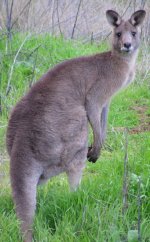
 Eastern grey kangaroos (Macropus giganteus) can be found along the eastern coastlines of Australia, South Wales, and parts of Eastern Tasmania, and Queensland with the exception of western Cape York. Eastern grey kangaroos are often confused with the West grey kangaroos, but are distinguishable by their more even distribution of fur colors. The eastern grey also has a much lighter face complexion than the western. Did you know a baby kangaroo is called a 'joey'? And that a group is called a 'mob'? These 'mobs' have one dominant male and about 2-3 females with young, and about 2-3 young males. The only natural predator, besides man, is the dingo, but the effect is not significant. The kangaroo industry is huge, considering the kangaroo industry is worth AUD$200 million per year and directly employs 4000 people, many of these jobs are in remote areas with few other employment opportunities (source, note: this is old, it probably is a lot more). The Viva ( Vegetarians International Voice for Animals) movement is calling it the largest wildlife massacre on the planet. The kangaroo industry produces kangaroo leather that is also used in soccer boots. Adidas produces one type of soccer boot that uses this leather: the predator (what an appropriate name). From Viva's website:
 "This (soccer boot) industry is vital to the kangaroo industry.
The Viva sued adidas in 2003, read it here.
In response to critics, the Kangaroo industry association of Australia responds on their website with:
"Commercially utilising wildlife, especially iconic species like kangaroos, challenges the widely publicised view of conservation pushed by the modern NGO conservation movement. Many people living in New York, London, Paris or Sydney and brought up on an ‘entertainment diet’ of wildlife documentaries would believe ALL wildlife is endangered. The fact that some species, like the commercially harvested kangaroos, are super-abundant and can be sustainably harvested as a resource does not get much publicity from groups like Greenpeace who are dependent on a ‘concerned’ public for their annual revenue.
For other people the thought of killing an attractive wild animal such as a kangaroo goes against their deeply held love of animals." (source)
Please share your thoughts on this and take care.
Keywords: red
Which zoos have them?
Los Angeles Zoo (United States)The Eastern grey kangaroo is listed as Least Concern (LR/lc), lowest risk. Does not qualify for a more at risk category. Widespread and abundant taxa are included in this category, on the IUCN Red List of Threatened Species
Namings for the eastern gray kangaroo
A young / baby of a eastern gray kangaroo is called a 'joey'. The females are called 'flyer or doe' and males 'boomer or buck'. A eastern gray kangaroo group is called a 'mob, troop or court'.Countries
AustraliaSome facts about the
Eastern gray kangaroo
Adult weight : 49.5 kg (108.9 lbs)
Maximum longevity : 25 years
Female maturity :639 days
Male maturity : 1290 days
Gestation : 36 days
Weaning : 319 days
Litter size : 1
Interval between litters : 342 days
Weight at birth : 0.001 kg (0.0022 lbs)
Weight at weaning : 4 kg (8.8 lbs)
