
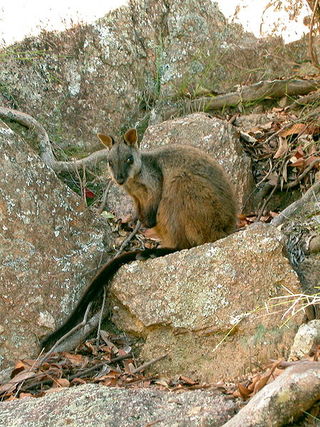
Original source: Own work, Boonoo Boonoo National Park, Australia
Author: Glen Fergus
Brush-tailed rock wallaby
Order : Diprotodontia
Family : Macropodidae
Species : Petrogale penicillata
Keywords: tail
The Brush-tailed rock wallaby, brush-tailed rock-wallaby, western rock wallaby is listed as Vulnerable (VU), considered to be facing a high risk of extinction in the wild, on the IUCN Red List of Threatened Species
Countries
AustraliaBrush-tailed rock wallaby habitats
Rocky areas (eg inland cliffs and mountain peaks)Some facts about the
Brush-tailed rock wallaby
Adult weight : 6 kg (13.2 lbs)
Maximum longevity : 14 years
Female maturity :540 days
Male maturity : 590 days
Gestation : 30 days
Weaning : 273 days
Litter size : 1
Interval between litters : 200 days
Weight at weaning : 0.735 kg (1.617 lbs)
Facts about the brush-tailed rock wallaby
22 BRUSH-TAILED ROCK-WALLABY (Petrogale penicillata) An endangered species The Brush-tailed Rock-wallaby (Petrogale penicillata) is a medium sized wallaby with a distinctive dark tail that is usually longer than the head and body and often has a conspicuous brush at the tip.
A fifth species, the Brush-tailed Rock Wallaby (Petrogale penicillata) is considered to be extinct locally, although a captive population is maintained at Tidbinbilla Nature Reserve as part of the national recovery program for this species.
Brush-tailed Rock Wallaby (Petrogale penicillata) is the prevalent assemblage species (Table IX.
Brush-tailed Rock Wallaby is the dominant species as represented by the number of elements (50 % of the total number of identified fragments [Table IX.
Brush-Tailed Rock Wallaby or Petrogale penicillata is listed on the IUCN Red list (1996) as Vulnerable due to C2a.
Christened the 'shadow' because they are extremely shy creatures which are difficult to see in the wild, the Brush-tailed Rock-wallaby is considered as Critically Endangered by the Victorian Government and Vulnerable by the Australian Government.
Rock-wallaby, Petrogale penicillata, is the only rock-wallaby present in eastern NSW.
South of Canberra, the Brush-tailed Rock-wallaby is now very rare (Short & Milkovits 1990, Lobert 1988, Norris & Belcher 1986).
The Brush-tailed Rock Wallaby is so rare in Australia that is has long been considered to be close to extinction.
The Brush-tailed Rock Wallaby, 'Petrogale penicillata ', is now only found in fragmented populations in Southern Queensland, New South Wales, and two locations in Victoria, Australia.
The Brush-tailed Rock-wallaby is a small, attractive animal with distinctive facial markings and a long bushy tail.
The Brush-tailed Rock-wallaby is also expected to be susceptible to the introduced diseases toxoplasmosis, carried by cats, and hydatidosis, carried by sheep.
The Brush-tailed Rock-wallaby Petrogale penicillata is a distinctively marked medium sized wallaby and one of the larger rock-wallabies.
The Brush-tailed Rock-wallaby Petrogale penicillata is a highly agile and distinctively marked medium-sized wallaby, which occupies rocky habitats.
The Brush-tailed Rock Wallaby is so rare in Australia that is has long been considered to be close to extinction. (Wiki)
The Brush-tailed Rock Wallaby or Small-eared Rock Wallaby (Petrogale penicillata) is a kind of wallaby, one of several rock wallabies in the genus Petrogale. (Wiki)
The Brush-Tailed Rock WallabyThe brush-tailed rock wallaby is a marsupial common in Queensland and New South Wales. (Full text)
The Brush-tailed Rock Wallaby (Petrogale penicillata) is native to Australia but in 1916 a pair escaped on O'ahu from captivity aftre being sold by a transient animal dealer to a local business man. (Full text)
More animals beginning with B