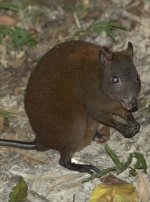
Musky rat kangaroo


StumbleUpon Toolbar Stumble this page!

Animal of the Day
Subscribe to the
animal of the day
Enter your Email


Powered by FeedBlitz

Top articles


Animals living in the water
Swim with manatees - harmful or helpful?

Pictures of the musky rat kangaroo are copyrighted
by their owners
Some facts about the
Musky rat kangaroo

Adult weight : 0.5 kg (1.1 lbs)

Female maturity :365 days

Male maturity : 365 days

Weaning : 270 days

Litter size : 2

Interval between litters : 365 days

Weight at weaning : 0.25 kg (0.55 lbs)

Source: AnAge, licensed under CC

Musky rat kangaroo

Order : Diprotodontia
Family : Potoroidae
Species : Hypsiprymnodon moschatus


Musky Rat-kangarooThe Musky Rat-kangaroo (Hypsiprymnodon moschatus) is the smallest kangaroo that has been most recently classified in the Hypsiprymnodontidae family along prehistoric rat-kangaroos. Some earlier scientists classified it as a Hypsiprymnodontinae subfamily belonging to the Potoroidae family. It generally dwells in the dampest areas, near rivers and creeks, of tropical rainforests in northeast Australia and New Guinea. It inhabits no other places but the lowlands and up to 1200 meter- highlands of the Wet Tropics. This terrestrial marsupial nests on a dwelling of dried fern and leaves usually in a Lawyer Vine clump.

The Musky Rat-Kangaroo is the smallest among macropods. The length is an average of about 230 millimeters and the weight about 520 grams, making the creature the smallest among all kangaroos. Its size is like a big guinea pig or a lot smaller brushtail possum or rabbit. Its closest modern-day living relatives are the wallabies and kangaroos. Aside from being the smallest, it is also considered as most primitive among macropods, with features similar to those of ancestors that resembled possums. This marsupial is the kangaroo family's only remaining member that retained a prehensile tail, which measures about 145 millimeters. The tail is scaly and bare, and it reminds one of glossy leather. Like possums and unlike kangaroos, it also has an opposable digit and first toe on its hind foot, enabling it to climb up fallen trees and branches. This marsupial can also have more than just one young in its pouch unlike the single baby trait of a kangaroo.

It feeds mainly on fruits and seeds at daytime. The Musky Rat-Kangaroo plays a vital role as a dispersal agent in the regeneration of plants in rainforests. It also eats small invertibrates. Its stomach, however, is simpler than those of its macropod relatives.

Interesting fact: Unlike kangaroos that jump on two legs, the musky rat-kangaroo hops like a bunny on all of its four legs. It pushes its longer hind legs in front outside its shorter fore legs when galloping.

Picture by PanBK, licensed under GFDL

The Musky rat kangaroo is listed as Least Concern (LR/lc), lowest risk. Does not qualify for a more at risk category. Widespread and abundant taxa are included in this category, on the IUCN Red List of Threatened Species
Namings for the musky rat kangaroo
A young / baby of a musky rat kangaroo is called a 'joey'. The females are called 'flyer or doe' and males 'boomer or buck'. A musky rat kangaroo group is called a 'mob, troop or court'.
Countries
Australia

Facts about the musky rat kangaroo

Musky Rat Kangaroos are our smallest and arguably most unusual macropod.

Now a rare and elusive animal that inhabits a few isolated patches of Queensland’s lowland rainforest, the tiny musky rat kangaroo is of an ancient lineage, with characteristics that put it very close to the direct link between the possums and the ancestors of modern kangaroos and wallabies.

The musk kangaroo, Hypsiprymnodon moschatus, is a ratlike wallaby living in the rain forest of northern coastal Queensland.

Food Habits Musky rat kangaroos are different from other rat-kangaroos in that they are primarily insectivorous. (Full text)

Hypsiprymnodon moschatus is considered to represent the earliest evolutionary stage linking an ancestral arboreal opossum to the kangaroos. (Full text)

The musky rat-kangaroo, Hypsiprymnodon moschatus, is traditionally allied with other potoroines based primarily on osteological characters and aspects of the female reproductive system. (Full text)

The Hypsiprymnodon moschatus is known the as musky rat-kangaroo, and the bettong as Bettongia penicillata. (Full text)

The musky rat-kangaroo is the only kangaroo to produce more than one single young. (Full text)

Musky Rat kangaroos are the smallest kangaroo in the world. (Full text)

A lovely tale about the inter-relatedness of all things and the musky rat-kangaroos are very lovely little creatures indeed. (Full text)

Whereas the Musky Rat Kangaroo is found only around the Cooktown area, the Rufous Bettong is widely spread from Cooktown to northern N. (Full text)

The musky rat-kangaroo is similar in shape, size and habit to this original kangaroo, with a lineage that stretched back over 15 million years making it the world's oldest living kangaroo. (Full text)

The musky rat-kangaroo is similar in shape, size and habit to this original kangaroo, with a lineage that stretched back over 15 million years making it the world's oldest living kangaroo. (Full text)

The Musky Rat-kangaroo is most closely related to the kangaroos and the wallabies. (Full text)

They Musky Rat-Kangaroos are seasonal breeders in response to variation in food (Full text)

The Musky Rat-kangaroo (Hypsiprymnodon moschatus) The Musky Rat-kangaroo, is a dark brown marsupial macropod (kangaroo family) (Full text)

Musky Rat-kangaroos are regular sightings during daylight hours under the fruit trees or along the rainforest pathways. (Full text)

The Musky-rat kangaroo is associated mainly with the, tall, complex rainforest of the south-east Tablelands, which is also endangered and classified by Tracey and Webb as Type 1b. (Full text)

" The Musky Rat-kangaroo is an example of a smaller macropod which is not nocturnal; it forages for fruit and small invertebrates in rainforest during the early morning and late afternoon. (Full text)

Musky rat-kangaroos are frugivores and consumed the fruits of 40 species of plant on a 9-ha rainforest site in Wooroonooran National Park, Queensland. (Full text)

The musky rat kangaroo is about the size of a bandicoot. (Full text)

1. Hypsiprymnodon, genus Hypsiprymnodon -- (musk kangaroos)
Hypsiprymnodon
genus Hypsiprymnodon
(Source WordNet)

Google
Contact Us | ©2008 TheWebsiteOfEverything.com | Pictures and facts about the Musky rat kangaroo