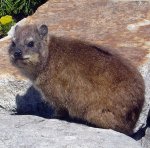
 The Cape Hyrax (Procavia capensis), like all hyraxes, slightly resembles a rabbit superficially. They live between the rocks and can often be found in burrows of other animals, like meerkats and aardvarks. People from South Africa call them "dassies" or "rock rabbits". "Dassie" means badger in German as well as in Afrikaans, which gives reason to believe the early colonist mistook the Cape Hyrax for a badger in the 17th century. Cape Hyraxes produce large amounts of dung and urine that has been used by locals in the treatment ofepilepsy and convulsions.
 Image: Dassie (Cape Hyrax) photographed on Table Mountain by Andreas Tusche, Cape Town. The photo was taken on the rocks near the upper cable car station. Licensed under GFDL
Keywords: tail
Which zoos have them?
Brookfield Zoo (United States), Los Angeles Zoo (United States), Saint Louis Zoological Park (United States) and Smithsonian National Zoological Park (United States)The Rock dassie, rock hyrax is listed as Least Concern. Does not qualify for a more at risk category. Widespread and abundant taxa are included in this category, on the IUCN Red List of Threatened Species
Countries
Algeria, Angola, Benin, Botswana, Cameroon, Chad, Congo, Democratic Republic of the, Egypt, Eritrea, Ethiopia, Ghana, Guinea, GuineaBissau, Israel, Jordan, Kenya, Lebanon, Lesotho, Libya, Mauritania, Mozambique, Namibia, Niger, Nigeria, Oman, Saudi Arabia, Senegal, Somalia, South Africa, Sudan, Swaziland, Syria, Tanzania, Togo, Turkey, Uganda, Yemen and ZimbabweRock hyrax habitats
Desert, Dry savanna, Hot Desert, Moist savanna, Rocky areas (eg inland cliffs, mountain peaks), Savanna, Shrubland, Subtropical / Tropical Dry Shrubland, Temperate Desert and Temperate ShrublandSome facts about the
Rock hyrax
Adult weight : 3.6 kg (7.92 lbs)
Maximum longevity : 15 years
Female maturity :500 days
Male maturity : 500 days
Gestation : 215 days
Weaning : 116 days
Litter size : 3
Interval between litters : 365 days
Weight at birth : 0.205 kg (0.451 lbs)
Weight at weaning : 0.5 kg (1.1 lbs)
Basal metabolic rate : 5 W
Body mass : 2.458 kg (5.4076 lbs)
Temperature : 36.85 °C (98.33 °F)
