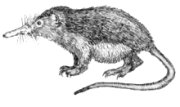
| Pictures of the Cuban solenodon are copyrighted by their owners |
|
Cuban solenodon
Order : Insectivora
Family : Solenodontidae
Species : Solenodon cubanus
The shrewlike Cuban Solenodon (Solenodon cubanus) has short legs and it possesses skin glands that produce a goat-like smell. Its elongated head has tiny eyes coupled with a flexible snout. Their fur could be any of the following: black, red-brown or dark brown. They could be found in both forests and scrublands, and in the main, they are terrestrial. However, the Cuban Solenodons have the ability to climb. At the ground level, they move with an unsteady gait, but for short lengths, a Cuban Solenodon could run quickly.At night when they are foraging for food, they use that snout to tear tree trunks. Their diet also consists of snakes, frogs, and crabs. A Cuban Solenodon is basically social, with many members residing in a single hole (burrow that is). A Cuban Solenodon communicates with others via squeaks, squeals and twitters. They comprise the family Solenodontidae, and this in turn belongs to a set of mammals termed as insectivores by the scientific community.
Wilhelm Peters discovered this breed of solenodons in 1861. By 1970, everybody thought they had gone extinct. Wrong, three individual solenodons were caught in the mid-70s. Still, they are rare in any part of the globe they exist in. Before 2003, the last sighting came in '99 and no wonder- they are night burrowers and they live in the basement, so to speak.
In 2003, one of them was captured and it raised the number of captured to 37 (they named it Alejandrito). It was released later on, after experts studied it for just a couple of days.
Interesting fact: The solenodon adults approach one another with their mouths open, probably giving out high-frequency sounds.
The Almiqui, cuban solenodon is listed as Endangered (EN), considered to be facing a very high risk of extinction in the wild, on the IUCN Red List of Threatened Species
Habitats
Artificial / Terrestrial, Caves, Caves and Subterranean Habitats (non-aquatic), Forest, Plantations and Subtropical / Tropical Dry forest
Facts about the Cuban solenodon
Cuban Solenodons are considered to be of Endangered status by the International Union for Conservation of Nature and Natural Resources Home
The Cuban Solenodon (known as the Almiqui in Cuba) (Solenodon cubanus) is an insectivore native to Cuba, believed extinct until rediscovered in 2003 in the eastern mountains.
The cuban solenodon is the link to
Behavior Cuban solenodons are nocturnal (Vaughn et al. (Full text)
Geographic Range Presently, Solenodon cubanus is limited to the Oriente Province in Cuba. (Full text)
Behavior: The Cuban solenodon is mainly , hiding during the day in rock clefts, hollow trees, or burrows which it excavates itself. (Full text)
The Cuban Solenodon (known as the Almiqui in Cuba) (Solenodon cubanus) is an insectivore native to Cuba, believed extinct until rediscovered in 2003 in the eastern mountains. (Full text)
ticon { position:relative; border:1 solid gray; top:-18; left:46; } MultimediafromEncartaGo to article|View all multimedia|Appears inCuban SolenodonOne of only two species of solenodon, the Cuban solenodon is a rare insectivore that resembles a large rat. (Full text)
Cuban SolenodonOne of only two species of solenodon, the Cuban solenodon is a rare insectivore that resembles a large rat. (Full text)
Habitat: The Cuban solenodon is found in dense, humid forests and brush country, as well as around plantations. (Full text)
Social Organization: Adult Cuban solenodons are solitary, other than mothers with young. (Full text)
Adult Cuban solenodons are solitary, other than mothers with young. (Full text)
The Cuban solenodon is an insectivore weighing about 1 kg (2. (Full text)
Not Extinct After All The almiqui, Solenodon cubanus, is a nocturnal insectivore once thought to be extinct. (Full text)
Other descriptions of Cuban Solenodon Cuban Solenodon Conservation status: Endangered Scientific classification Kingdom: Animalia Phylum: Chordata Class: Mammalia Order: Insectivora Family: Solenodontidae Genus: Solenodon Species: cubanus Binomial name Solenodon cubanus Peters, 1861 The Cuban Solenodon (known as the Almiqui in Cuba) (Solenodon cubanus) is an insectivore native to Cuba, believed extinct until rediscovered in 2003 in the eastern mountains. (Full text)
The Cuban Solenodon is also in grave danger of extinction. (Full text)
1. copper, Cu, atomic number 29 -- (a ductile malleable reddish-brown corrosion-resistant diamagnetic metallic element; occurs in various minerals but is the only metal that occurs abundantly in large masses; used as an electrical and thermal conductor)copper
Cu
atomic number 29
(Source WordNet)