
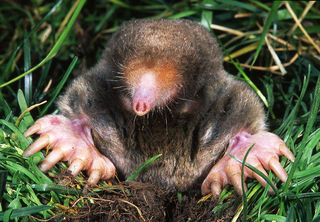
Original source: National Science Foundation http://nsf.gov/news/mmg/mmg_disp.cfm?med_id=64599&from=img
Author: Kenneth Catania, Vanderbilt University
Eastern mole
Order : Insectivora
Family : Talpidae
Subfamily : Talpinae
Species : Scalopus aquaticus
The Eastern mole is listed as Least Concern (LR/lc), lowest risk. Does not qualify for a more at risk category. Widespread and abundant taxa are included in this category, on the IUCN Red List of Threatened Species
Namings for the eastern mole
A young / baby of a eastern mole is called a 'pup'. A eastern mole group is called a 'labour,company or movement'.Some facts about the
Eastern aquatic mole
Adult weight : 0.09 kg (0.198 lbs)
Female maturity :335 days
Male maturity : 335 days
Gestation : 36 days
Weaning : 36 days
Litter size : 3
Litters per year : 1
Weight at birth : 0.005 kg (0.011 lbs)
Body mass : 0.048 kg (0.1056 lbs)
Temperature : 35.85 °C (96.53 °F)
Facts about the eastern mole
Geographic Range Scalopus aquaticus is found from southeastern Wyoming, South Dakota, and central Texas east to Michigan, Massachusetts, and New England, south to the tip of Florida, and north to Ontario. (Full text)
Scalopus aquaticus is found from southeastern Wyoming, South Dakota, and central Texas east to Michigan, Massachusetts, and New England, south to the tip of Florida, and north to Ontario.
Collected: Shoreview, Ramsey County, Minnesota The Common, or Eastern, Mole Scalopus aquaticus is an abundant mammal in much of our region. (Full text)
Of these, the Eastern Mole (Scalopus aquaticus) is most common in Ohio.
GEOGRAPHIC RANGE: Scalopus aquaticus is found from southeastern Wyoming, South Dakota, and central Texas east to Michigan, Massachusetts, and New England, south to the tip of Florida, and north to Ontario. (Full text)
GEOGRAPHIC RANGE: Scalopus aquaticus is found from southeastern Wyoming, South Dakota, and central Texas east to Michigan, Massachusetts, and New England, south to the tip of Florida, and north to Ontario. (Full text)
) The eastern mole, Scalopus aquaticus, is a mostly solitary creature that lives in well-drained, loamy soils.
Scalopus aquaticus is the eastern mole and the primary culprit among the dozen or some mole species found in North America. (Full text)
Possessing eyes completely covered with skin, the highly-fossorial Eastern mole is perhaps the species most ideally structured for life underground.
Range Maps Threats: The Eastern Mole is at the northern limit of its range in Ontario and so was never common here.
the great lawn destroyer, the Eastern Mole, is all nestled down in his burrow.
Conservation Status The eastern mole is not endangered but has suffered persecution by avid gardeners and farmers who are displeased by the mounds of earth left behind and by the root damage caused by this animal. (Full text)
The tail of an eastern mole is short (0. (Full text)
The tail of an eastern mole is short (0.
The eastern mole is classified as Scalopus aquaticus, the western mole as Scapanus townsendii, the hairy-tailed mole as Parascalops breweri, the star-nosed mole as Condylura cristata, and the shrew mole as Neurotrichus gibbsii. (Full text)
Description: Eastern moles are related to shrews, and of the four kinds of insectivores in Kansas, they are best adapted to underground life. (Full text)
eastern mole Eastern Mole Scalopus aquaticus The Wildlife Services Image Collection Eastern Moles are small mammals which are rarely seen.
Eastern MoleEastern moles are related to shrews, and of the four kinds of insectivores in Kansas, they are best adapted to underground life. (Full text)
Eastern moles are active any time of the day but are most active from 4 to 7 a.
Eastern moles are insectivores and feed primarily on grubs and earthworms.
Eastern moles are 14.
There are two species of moles in southern Michigan: Eastern moles are by far the most common species in suburban yards, while star-nosed moles are found mostly in damp soils near ponds, marshes, or other wetlands, and sometimes even swim and feed underwater.
More animals beginning with E