
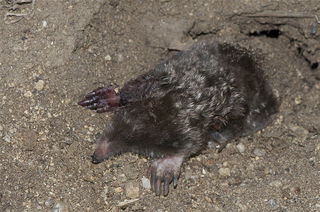
Original source: http://www.flickr.com/photos/jkirkhart35/3666731429/
Author: jkirkhart35
Townsend's mole
Order : Insectivora
Family : Talpidae
Subfamily : Talpinae
Species : Scapanus townsendii
The Townsend's mole is listed as Least Concern (LR/lc), lowest risk. Does not qualify for a more at risk category. Widespread and abundant taxa are included in this category, on the IUCN Red List of Threatened Species
Namings for the Townsend
A young / baby of a Townsend is called a 'pup'. A Townsend group is called a 'labour,company or movement'.
Facts about the Townsend's mole
More restricted in distribution than the coast mole, Townsend's mole is typically a lowland species that occurs from extreme northwestern California in the south, and upwards along the coastal regions of Oregon and Washington.
Similar Species Townsend's Mole is much larger, with unevenly spaced, crowded unicuspids.
Townsend's mole is usually the more abundant of the two.
Townsend's moles are the largest and heaviest North American talpids.
Townsend's moles are the largest and heaviest North American talpids. (Full text)
Townsend's Mole is the largest of the western moles, genus Scapanus, and may reach a length of over 9 inches. (Full text)
Townsend's mole More restricted in distribution than the coast mole, Townsend's mole is typically a lowland species that occurs from extreme northwestern California in the south, and upwards along the coastal regions of Oregon and Washington. (Full text)
Townsend's moles are the largest and heaviest North American talpids. (Full text)
Description The Townsend's Mole is the largest North American mole. (Full text)
Habitat Townsend’s Moles are adapted for digging, spending most of their lives underground. (Full text)
More animals beginning with T