
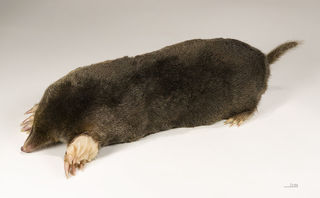
Author: Didier Descouens
European mole
Order : Insectivora
Family : Talpidae
Subfamily : Talpinae
Species : Talpa europaea
The European mole is listed as Least Concern (LR/lc), lowest risk. Does not qualify for a more at risk category. Widespread and abundant taxa are included in this category, on the IUCN Red List of Threatened Species
Namings for the European mole
A young / baby of a European mole is called a 'pup'. A European mole group is called a 'labour,company or movement'.Countries
Albania, Andorra, Austria, Belarus, Belgium, Bosnia and Herzegovina, Bulgaria, Croatia, Czech Republic, Denmark, Estonia, Finland, France, Germany, Greece, Hungary, Italy, Latvia, Liechtenstein, Lithuania, Luxembourg, Moldova, Monaco, Netherlands, Poland, Romania, Russia, Serbia and Montenegro, Slovakia, Slovenia, Spain, Sweden, Switzerland, Turkey, Ukraine and United KingdomSome facts about the
European mole, common mole
Adult weight : 0.093 kg (0.2046 lbs)
Female maturity :182 days
Male maturity : 182 days
Gestation : 28 days
Weaning : 31 days
Litter size : 3
Litters per year : 1
Weight at birth : 0.003 kg (0.0066 lbs)
Weight at weaning : 0.052 kg (0.1144 lbs)
Facts about the European mole
Most common in grassland and pasture, European moles are found at sea level and at high altitudes in almost every type of soil.
The mole (Talpa europaea) is a common British mammal and although rarely seen, due to its subterranean existence, its presence is well marked by the appearance of 'molehills' above ground, produced as a result of its underground tunnelling activity.
The mole (Talpa europaea) is a common British mammal and, although not often seen, the results of
The typical and most widespread European mole is the common mole, but there are also the blind mole and Roman mole found in some parts of Europe.
The European mole (Talpa europaea) is widely distributed throughout temperate parts of Europe and Asia. (Full text)
The European Mole, Talpa europaea, is a mammal of the order Insectivora. (Wiki)
European moles are still considered a pest species in some countries, but this tends to apply only to regions of highly developed agriculture (see Stone, 1989 for overview). (Full text)
Habitat: The European mole is an adaptable species and is present in most habitats where the soil is sufficiently deep to allow tunnel construction. (Full text)
The European mole (Talpa europaea) is one of the few insectivores to have been hunted for its fur. (Full text)
[1913 Webster] Note: The common European mole, or moldwarp (Talpa Europaea ), is noted for its extensive burrows. (Full text)
Digging Deep: RNAlater Goes Underground Zoophysiologists speculate that the high blood oxygen affinity found in the European mole (Talpa europaea) is an adaptation to subterranean life. (Full text)
Diet The European mole is entirely carnivorous: it consumes about its own bodyweight of food per day, mainly composed of earthworms. (Full text)
To: Registered The European mole is a small animal with a pointed snout, large digging forepaws and very small eyes. (Full text)
A European mole is placed on a marble column, given the same display that emeralds receive in the mineral galleries upstairs. (Full text)
More animals beginning with E